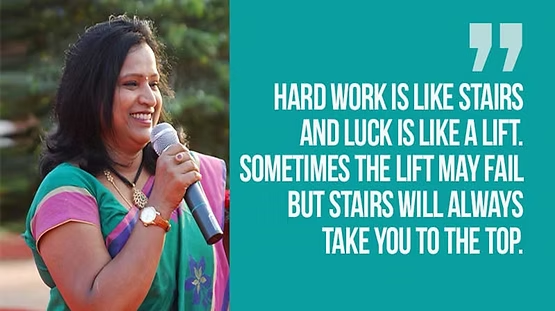
In 1989, a 19-year-old woman stood at the edge of a 200-foot deep well in rural Telangana, India.
She was a farm labourer. She hadn’t eaten in a day. She was earning ₹5 — less than ten cents — for a full day’s work bent over in the paddy fields, leeches on her feet, her two infant daughters crying from hunger on a patch of dry ground nearby.
She looked into the well. She had decided that this was the end.
And then her daughter cried.
That cry — that single sound — stopped everything. She stepped back. She ran to her children. And she made a decision that would take her from those fields in Warangal to the CEO’s chair of a multimillion-dollar software company in Phoenix, Arizona.
Born Into Hunger in Warangal
Jyothi was born the second of five children to Venkat Reddy, a farmer in Warangal district, Telangana. Her father’s monthly income of ₹400 was barely enough to feed the family. “We’d survive on two meals a day, wear torn clothes, had no footwear and lived in a thatched hut with no electricity,” she recalled in an interview with Gulf News.
When drought worsened the family’s finances, her father made a painful decision: he sent nine-year-old Jyothi and her seven-year-old sister to an orphanage — the Bala Sadanam in Hanamkonda — so they could at least get an education and three meals a day. (Gulf News)
Her sister could not bear the separation and was eventually sent home. Jyothi chose to stay. “I’d get three square meals plus I had the option to study, so I decided to stay back. I enjoyed school and dreamt of eventually earning a doctorate,” she said. (Gulf News)
She passed Class 10. And then her father arrived — not to celebrate, but to take her home to get married.
Married at 16, Mother at 18
In 1985, at the age of 16, Jyothi was married to a farmer ten years her senior. She had no say in the matter. “From dreaming of an education at 16, I was suddenly thrown into marriage, doing household chores and working in the fields,” she told Gulf News. (Gulf News)
By the time she was 18, she was a mother of two daughters — Beena and Bindu — and working as a daily wage farm labourer for ₹5 a day. Her husband’s family was also poor. The combined income was not enough for three proper meals. There were days she had nothing to feed her children. (ScoopWhoop)
Her marriage was also marked by constant conflict. “My husband and I quarrelled often, and I was feeling extremely frustrated and dejected in life,” she said. (Gulf News)
This was the world she was living in on the morning she walked towards that well.
The Moment at the Well
It was early 1989. Jyothi was in the paddy field, bent over planting saplings under a blazing sun, her last meal more than a day ago. Her daughters were crying from hunger on the ground nearby. She was earning ₹5 for the entire day’s labour.
She walked to a nearby well. She looked in. She had decided this was the end of the road. (Gulf News)
Then her daughter cried.
Jyothi stepped back. She ran to her children. She held them. And she made herself a promise: “I can’t give up so easily.”
In an interview twenty-five years later, she said she still shudders when she recalls that day. It was the moment, she says, that everything changed — not because her circumstances changed, but because she decided they would. (Gulf News)
From ₹5 a Day to ₹120 a Month — One Door at a Time
A few months after that day, Jyothi heard that a night school in her area needed an adult education teacher. She was the most educated woman in her village. She got the job at ₹120 a month. (Jaago Re)
“It was as if I had got one lakh rupees. I could now spend on my children’s medicine. It was a lot of money for me,” she told ScoopWhoop.
She got a promotion — now travelling to neighbouring villages to build youth clubs and women’s associations. Her in-laws and husband disapproved. When the conflict at home became unbearable, she made another life-defining decision: she packed two saris, a few clothes for her daughters, a bag of rice and some pans — and left.
On May 21, 1990, she and her daughters arrived in Hanamkonda with nothing but those belongings and ₹190 a month in income. She rented a room for ₹60 a month. There were times, she says, when she rummaged through garbage bins for discarded vegetables, cleaned them, and cooked them for her children. (Gulf News)
To earn extra, she borrowed a sewing machine and started making dresses. She took a typewriting course. She got a job as a librarian. She enrolled in an open university degree programme — studying whenever she had a spare hour. She got a teaching post that required a two-hour train journey each way. To cover the travel cost, she borrowed ten saris from a textile shop contact and sold them to passengers on the train, earning ₹20 commission per sale. (Gulf News)
She earned her BA from Dr B.R. Ambedkar Open University in 1994. She completed her Master’s degree in sociology and public administration — from Kakatiya University in 1997, studying on weekends. By 1998, she had been appointed as a girl-child development officer, setting up early childhood centres and village playschools. (Project Never Give Up)
The farm labourer who earned ₹5 a day had become a government officer. But she wasn’t done.
The Cousin, the Visa, and the Flight to America
In 1998, a cousin named Jaya Lakshmi visited from the United States. Seeing the difference in their lives, something stirred in Jyothi. On impulse, she asked her cousin to help her get to America. She had no passport. She could barely speak English. She asked anyway. (Gulf News)
She spent the next two years preparing — enrolling in a computer programme, completing her MA, gathering the documents and the courage she needed. She enrolled her daughters in a residential school, not wanting to uproot them. (The Better India)
In May 2000, at the age of 30, she boarded a flight to San Francisco. Alone. (Gulf News)
In the US, she worked as a babysitter, a sales assistant, a gas station attendant, and a motel worker. She applied for software jobs without success. She kept going. Eventually, she found her way into a software recruiting firm called CS America — and discovered she had a talent for connecting people and opportunities. (The Better India)
A well-wisher suggested she start her own company. She had saved $40,000. She said yes.
Key Software Solutions: Built from Scratch
In October 2001, Jyothi rented a small office in Phoenix, Arizona, hired two employees, and launched Key Software Solutions — a software recruiting company. (Gulf News)
The woman who had once rummaged through rubbish bins for discarded vegetables was now running her own business in the United States.
She put everything she had into it. Today, Key Software Solutions employs over 200 people and has an annual turnover of $15 million. Her two daughters — who once cried from hunger in a paddy field while their mother worked for ₹5 a day — are now engineers, both settled and thriving in the US. (Gulf News)
Her biography, titled Aina Nenu Odipoledu (meaning “Yet I Am Not Defeated”), has been published in Telugu. Her life story has been included as a chapter in the English textbooks of Kakatiya University, Andhra Pradesh. She is now a regular speaker at schools, colleges, and forums across India and the world. (Gulf News)
Giving Back: The Woman Who Never Forgot
Jyothi has not forgotten where she came from. She returns to India regularly — on her birthday, she visits orphanages in Warangal, the same district where she once earned ₹5 a day. She sponsors a home for 220 children with mental disabilities. (The Logical Indian) She has joined hands with NGOs, including Prajadharana Welfare Society, MV Foundation, and Child Rights Advocacy Forum, to form FORCE (Force for Orphan Rights and Community Empowerment) — a pressure group fighting for orphan children to receive legal identity, government recognition, and equal rights. (JyothiReddy.in)
She is also working towards a dream project that will provide employment to over 1,000 young people and establish a school running from kindergarten through to postgraduate level.
“I tell women to be independent. They should not consider marriage as the end of their life — only a part of it,” she says. (Gulf News)
What Her Story Actually Teaches
Jyothi Reddy did not have a single advantage. No family money. No connections. No formal education until an orphanage gave her one. No freedom to choose her own path — until she chose it anyway, at enormous personal cost, one small step at a time.
She didn’t go from farm labourer to CEO in one leap. She went from ₹5 to ₹120 to ₹398 to ₹6,000 to $60 to $40,000 in savings to a $15 million company — one relentless, exhausting, determined step at a time.
Every time the world told her this was as far as she would go, she found another door. Borrowed a sewing machine. Sold saris on a train. Learned to type. Got a degree. Got another degree. Knocked on a stranger’s door and asked to go to America.
And she did it all with two daughters depending on her. For them. Because of them.
The title of her biography says everything: Yet I Am Not Defeated.
Whatever you are carrying right now — whatever walls are closing in, whatever voice is telling you this is as far as you go — remember the woman who stepped back from a well in a rice paddy in Warangal and decided her daughters deserved more.
You are the creator of your own destiny. Her words. Her life. Her proof.
Never give up.
Inspired by this story? Read about how Sylvester Stallone said no to $350,000 while homeless, or how Amitabh Bachchan was rejected for his voice and still became India’s greatest actor.
Sources
- Gulf News — From Farm Labourer to CEO
- The Better India — Jyothi Reddy’s Incredible Journey
- ScoopWhoop — From Farm Labourer to CEO of a Million Dollar Company
- Jaago Re — From Farmer to CEO: A Mother’s Tale
- Dr. B.R. Ambedkar Open University
- The Logical Indian — Jyothi Reddy’s Journey
- JyothiReddy.in — Official Biography