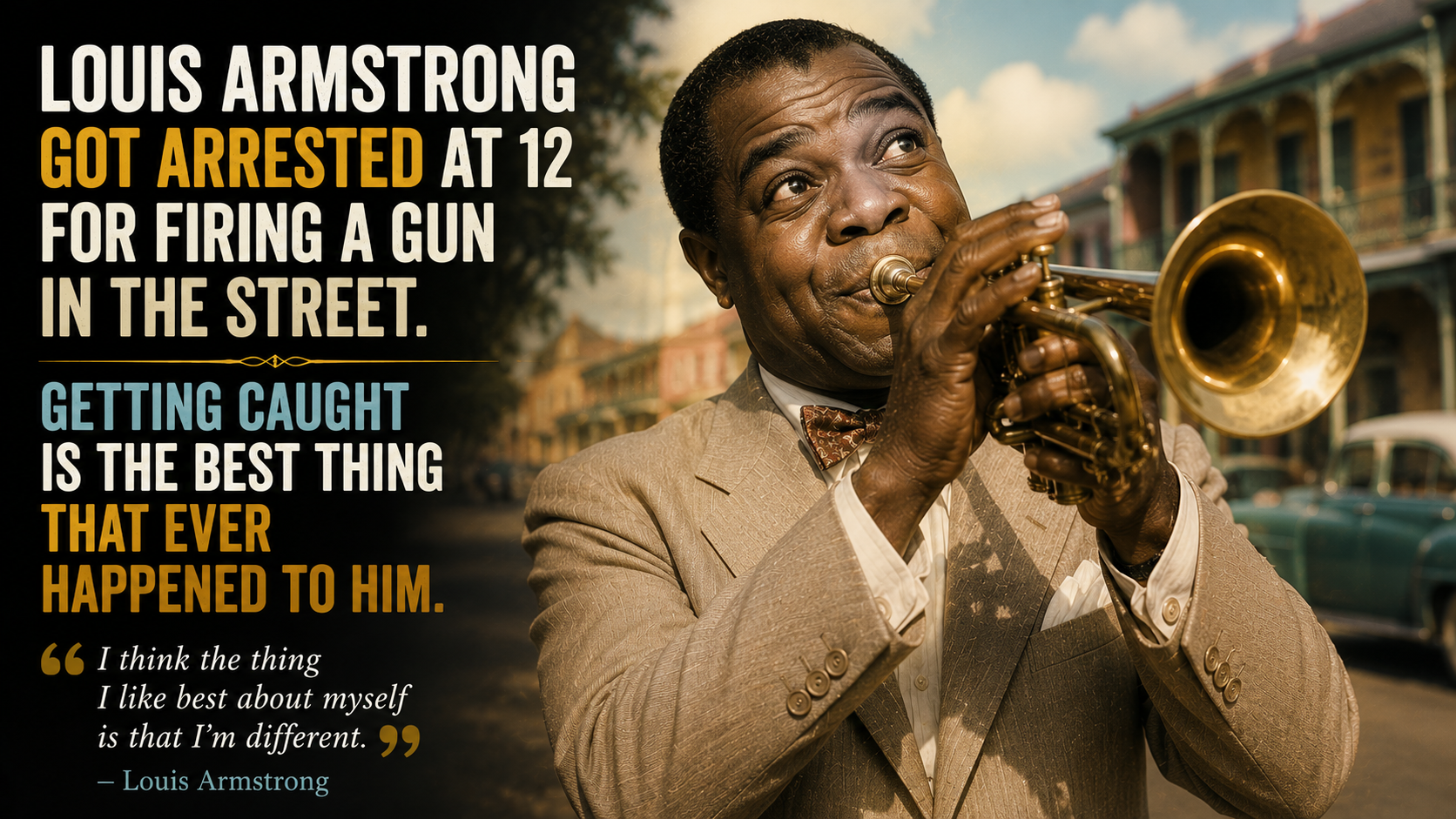
In brief: Louis Armstrong grew up dirt poor in a New Orleans neighborhood so rough it was nicknamed “The Battlefield.” At 12, he was arrested and sent to a reform school. It’s where he got his first real music lessons. He later said the arrest changed his entire life for the better — and he meant it.
What if the worst night of your childhood turned out to be the reason you became who you were always meant to be?
I know that sounds like something people say to make hard things feel okay in hindsight. Stick with me, though, because Louis Armstrong actually lived this. Not as a nice phrase. As his real life, starting with a gunshot he fired into the air when he was 12 years old.
The Battlefield
Armstrong was born in New Orleans in 1901, in a neighborhood people actually called “The Battlefield.” That wasn’t a nickname somebody made up to sound tough. It was real poverty, real danger — gunfire in the streets was just part of daily life there. (America Comes Alive)
His father left not long after his sister was born. His mother got sick, struggled to care for both kids, so young Louis spent his first five years mostly raised by his grandmother, Josephine — the one steady thing in an otherwise unstable childhood. Money was always tight. He remembered, later in life, going without shoes simply because his family couldn’t afford a pair. (America Comes Alive)
He left school after fifth grade. Around age 11. Not because he wanted to. Because his family needed him working. He sold newspapers. Hauled coal. Even cleaned graves for tips. Whatever he earned, he brought straight home. “I would make a bee line for home and dump my share into mama’s lap,” he said later. (Historical Snapshots)
Can you imagine being 11 and already carrying that? No time to just be a kid. No room to figure out what you’re actually good at, because every day is about getting through it. I think a lot of people reading this know some version of that feeling — even if your circumstances looked completely different, that specific weight of “I don’t have room to be anything other than useful right now.”
The Music Never Left, Though
Even with all of that, music stayed with him. New Orleans, back then, was maybe the most musical city in America — it was everywhere. Church. The streets. Every club in his neighborhood. Armstrong couldn’t afford an instrument, so around age 10, he started singing on street corners with a few friends, earning tips from anyone who stopped to listen. “Music has been in my blood from the day I was born,” he wrote, years later. (FEE)
He got a job with the Karnofsky family, Jewish immigrants who ran a junk business in his neighborhood and treated him with a kindness he remembered his whole life. What he saved from that job went toward the one thing he really wanted — a cornet of his own. (Louis Armstrong House Museum)
Then Came New Year’s Eve
1912. Armstrong was out with his singing group, caught up in the loud, chaotic celebration that took over New Orleans every year — the kind of night where people fired guns into the air almost as casually as fireworks. His mother’s boyfriend at the time kept a pistol hidden in a trunk. Armstrong took it without asking.
When gunfire rang out nearby, his friends egged him on to fire back, same as everyone else on the street. He hesitated.
Then he did it. One shot, straight up. (America Comes Alive)
He was arrested almost immediately. And because of the segregated laws of the time, Black kids in trouble weren’t sent to just any juvenile facility — they went to a specific one. Armstrong ended up at the Colored Waif’s Home for Boys, a reform school, arriving with a reputation already working against him, since his neighborhood was already known to the staff as trouble. (America Comes Alive)
If that had happened to you — one impulsive decision, on one chaotic night, and suddenly you’re locked up — what would you have expected to happen next? I think most of us would expect the story to get worse from there. It didn’t.
What Actually Happened Behind Those Walls
The Waif’s Home had a band. And the man running it, Peter Davis, heard something in Armstrong worth developing. He didn’t just let him join — he taught him. Real instruction. Real technique. Not the street-corner singing Armstrong had grown up doing, but proper training on the cornet. Armstrong picked it up fast enough that he eventually became the leader of the Home’s own brass band. (Louis Armstrong House Museum)
Years later, Armstrong looked back on that arrest with total clarity about what it had actually given him. This isn’t him putting a brave face on a hard memory. Read what he actually said: “I do believe that my whole success goes back to that time I was arrested as a wayward boy at the age of thirteen, because then I had to quit running around and began to learn something.” (Historical Snapshots)
Sit with that for a second. He’s saying the arrest — the thing that should have wrecked his life — is the exact reason he became who he became. Because for the first time, someone gave him room to actually focus on something.
What He Built With That Room
He spent about a year and a half at the Home, released around age 14. Instead of drifting back into the scattered odd jobs from before, he went all in on music — playing anywhere that would have him, including, by his own description, some genuinely rough places. (FEE)
He caught the attention of Joe “King” Oliver, the best cornet player in New Orleans at the time. Oliver became more than a mentor — by most accounts, something closer to a father — giving Armstrong his first really good cornet and coaching him directly. When Oliver moved to Chicago in 1919, Armstrong stepped into his place in the local scene. (Windsong Press biography archive)
In 1922, Oliver called him up to Chicago to join his band. It was everything Armstrong had been working toward, and his playing there made him the talk of the city’s music scene almost overnight — the real beginning of a career that would eventually make him one of the most recognized musicians who ever lived. (Windsong Press biography archive)
Here’s the Part I Keep Coming Back To
It’s tempting to tell this as a simple story — troubled kid gets in trouble, reform school straightens him out, success follows. But that’s not quite it, and I don’t want to leave you with the wrong lesson. Armstrong’s talent was already there. You can hear it in the street-corner singing, in his own words about music being “in his blood.” The reform school didn’t create that. What it gave him was something his life had never offered before: structure, a real teacher, and enough stability to actually practice.
Is there something like that for you? A skill or a passion you’ve never had the space to properly develop — not because you don’t have what it takes, but because you’ve simply never had the room? What would change for you if, even by accident, you were suddenly handed eighteen months with nothing to do but focus on it?
What His Story Actually Teaches
I don’t think the lesson here is “getting in trouble is secretly good for you.” That’s too simple, and honestly a little dishonest. What actually happened is more specific: an unwanted interruption placed him, by chance, in the one environment structured enough to develop a talent his daily life had never given him room for.
That’s more useful than “everything happens for a reason.” It’s closer to this: sometimes the worst-looking moment knocks you out of a pattern you were stuck in. What you do with the space it opens up is entirely on you.
Armstrong didn’t waste his eighteen months. He built the foundation for a six-decade career that helped shape American music. So here’s my real question for you: whatever unwanted pause or setback you’re in right now — a job loss, a forced break, a consequence you didn’t choose — what room has it actually opened up? Have you looked yet? Never give up.
Frequently Asked Questions
Why was Louis Armstrong sent to reform school?
At around 12 years old, he was arrested for firing a pistol into the air during New Year’s Eve celebrations in New Orleans in 1912, and sent to the Colored Waif’s Home for Boys. (America Comes Alive)
Did he learn music at the reform school?
Yes. Music instructor Peter Davis taught him to properly play the cornet there, and Armstrong went on to lead the Home’s brass band. (Louis Armstrong House Museum)
Who mentored Louis Armstrong afterward?
Joe “King” Oliver, New Orleans’s top cornetist, mentored him closely and later invited him to Chicago in 1922 — the real start of his national career. (Windsong Press biography archive)
Did Armstrong regret the arrest?
No — he directly credited it with changing his life for the better, saying it was where he finally had the structure and time to “begin to learn something.” (Historical Snapshots)
If you’re in an unwanted pause right now, talk to Risha — your AI friend, here any time you need help figuring out what to do with it.
Get a story like this every week: Join the Project Never Give Up newsletter — it’s free.