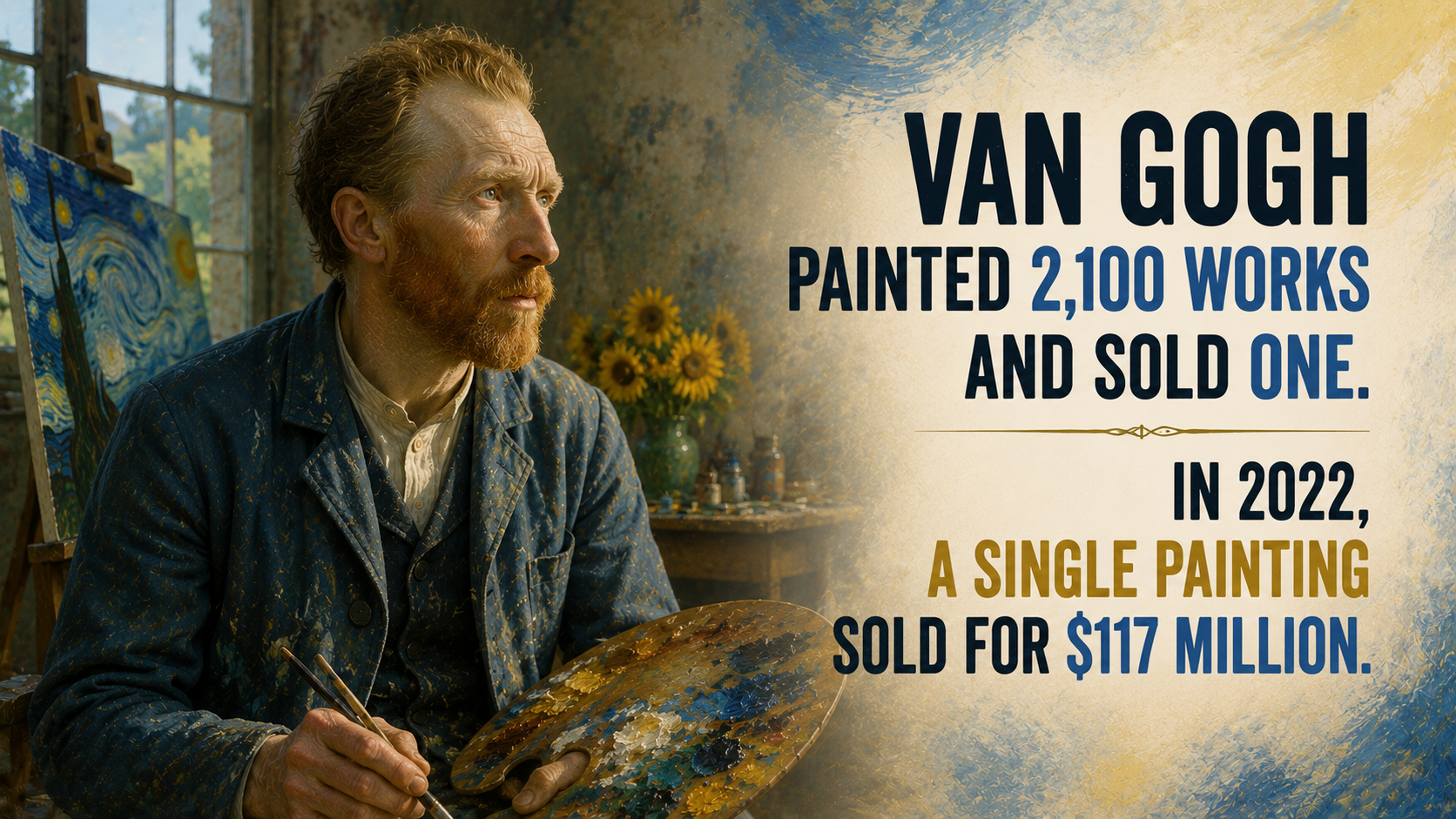
In brief: Vincent van Gogh made around 2,100 paintings and drawings in his lifetime. He’s documented to have sold exactly one, for 400 francs, four months before he died. He never knew what any of it would become. I think that’s the part of his story worth actually sitting with.
What would it feel like to work at something with everything you have, for an entire decade, and get almost no sign it’s landing?
Not one bad review. Not one slow year. A full decade of near silence, while you keep making things anyway, because you believe in them even when the world gives you no reason to.
That’s not a hypothetical for Vincent van Gogh. That’s just what his life was.
The One Sale
In March 1890, at an exhibition in Brussels, a painter named Anna Boch bought a landscape from van Gogh for 400 francs — roughly $2,000 today. It was called The Red Vineyard. In a letter to his brother Theo, van Gogh actually felt a little embarrassed about it — like a friend such as Boch should’ve gotten a better price than what he’d charged her at face value. (The Art Newspaper)
Four months later, he was dead. He was 37.
That sale to Anna Boch is the only documented instance, in his entire life, of Vincent van Gogh selling a painting to someone outside his family. One. (My Modern Met)
Sit With the Number for a Second
He didn’t start painting seriously until his late twenties — already a late start, by most standards, and one he never really outran while he was alive. Over roughly a decade of work, he made an estimated 900 paintings and over 1,100 drawings. That’s a volume most working artists would consider a full career many times over. (CompleteEra)
Almost none of it sold. He gave paintings away to friends. He bartered them for food and supplies with local shopkeepers. His brother Theo, an art dealer, supported him financially for most of his adult life and tried — mostly without success — to place his work with galleries and collectors.
How do you keep making something, at that volume, with that little external proof it matters? I genuinely don’t know if I could. I think most people would have stopped by year three.
What He Never Got to Know
Van Gogh never saw what came after him. He never knew Portrait of Dr Gachet would sell for $82.5 million. Never knew Irises would go for $53.9 million. Never knew that in 2022, a single canvas — Orchard with Cypresses — would sell at Christie’s for $117 million, one of the fifteen most expensive paintings ever auctioned. (CyPaint; My Modern Met)
He never knew that the very painting he sold, almost apologetically, for 400 francs to a friend, would today be worth tens of millions. He worked, essentially, in a vacuum. No real validation, ever, for the entire span of his career. (The Conversation)
I keep thinking about that gap — between what he actually experienced and what the world eventually decided his work was worth. It’s not a small gap. It’s the entire distance between total obscurity and $117 million. And he was gone before any of it closed.
What Actually Kept Him Working
This isn’t a story about eventual vindication, because van Gogh never got any. It’s a story about what it takes to keep making serious, ambitious work for a decade with almost no external signal that it matters.
His letters to Theo — hundreds of them, remarkably preserved — show a man who was completely clear-eyed about his lack of commercial success, and who kept working anyway, because he believed, on the evidence of the work itself, that something in it was true. Before The Red Vineyard sold, he described it simply: “a painting that I hope will sell.” A small, plain hope, stated without much confidence, from a man who by then had every reason to expect disappointment. (CompleteEra)
What I Actually Want You to Take From This
I don’t think van Gogh’s life proves that persistence always gets rewarded. It didn’t for him. Not while he was alive to see it, anyway. What it actually shows is something quieter and, I think, more useful: the work can be right long before anyone is positioned to see it.
So here’s what I want to ask you. Is there something you’re making, or building, or trying — where you’re doing genuinely good work, and getting almost nothing back to confirm it? No sales. No recognition. No signal.
What would it take for you to keep going anyway, the way he did — not because you know it’ll pay off, but because you trust the work itself is telling you something true? The market wasn’t wrong about van Gogh forever. It was just working on a timeline that had nothing to do with the timeline of his life. I can’t promise your timeline will be shorter. I can tell you the work not being seen yet isn’t the same as the work being wrong. Never give up.
Frequently Asked Questions
How many paintings did van Gogh sell while he was alive?
Only one is documented with certainty — The Red Vineyard, sold to Anna Boch for 400 francs in 1890. A few other minor sales may have occurred, but the well-documented number is one. (My Modern Met)
How much is that painting worth today?
The Red Vineyard isn’t on the market — it’s in the Pushkin State Museum in Moscow — but comparable van Goghs from the same period have sold for tens of millions at auction. (The Art Newspaper)
How many works did van Gogh actually make?
Roughly 900 paintings and over 1,100 drawings across about a decade — an estimated 2,100 pieces total. (CompleteEra)
Did van Gogh know he’d become famous?
No. He died in 1890 with almost no commercial recognition. His fame grew after his death, driven substantially by his sister-in-law Jo van Gogh-Bonger, who championed his work. (The Conversation)
If you’re making something the world hasn’t recognized yet, talk to Risha — your AI friend, here any time you need to talk it through.
Get a story like this every week: Join the Project Never Give Up newsletter — it’s free.