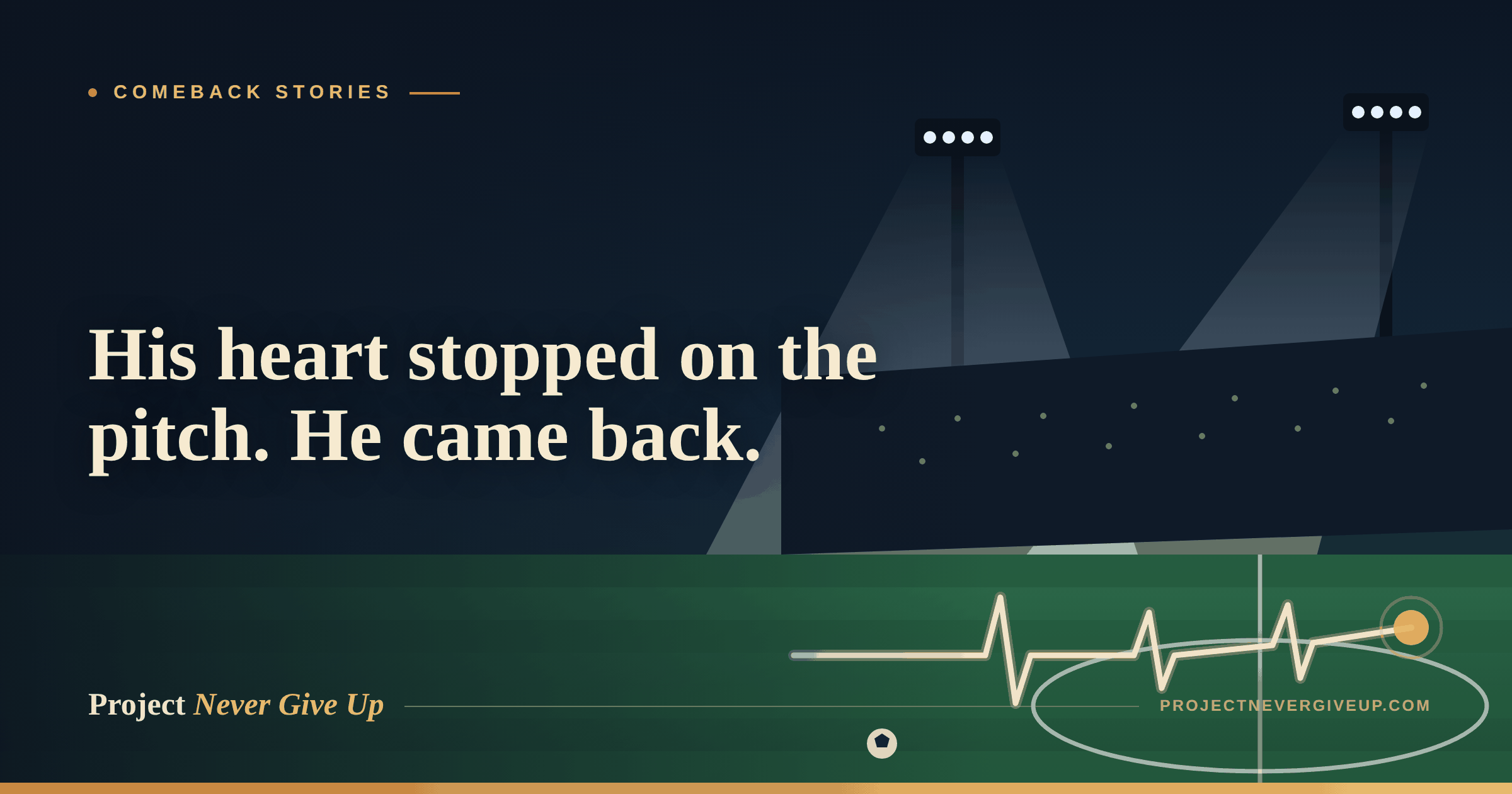
In brief: On June 12, 2021, Danish midfielder Christian Eriksen collapsed on the pitch at Euro 2020 and was clinically dead for several minutes. As paramedics worked to resuscitate him, he told them to keep his boots — he was done with football. 259 days later he made his Premier League comeback. He then went to the World Cup. He then signed for Manchester United. This is the story of what happened between the pitch in Copenhagen and the rest of his career.
The game had been going for 43 minutes. Denmark were playing Finland at Parken Stadium in Copenhagen on June 12, 2021. Christian Eriksen — 29 years old, one of the best midfielders in Europe, playing in front of his home crowd — received the ball, passed it, took one step and fell face-forward onto the grass.
He was not pushed. He was not tackled. His heart had simply stopped. His teammates formed a protective circle as medical staff rushed on. His captain, Simon Kjaer, held Eriksen’s head and cleared his airway. The defibrillator was used. His heart was restarted. He was carried off on a stretcher, hand raised to the crowd — he was alive. (CNN)
Later, in hospital, he asked if anyone had kept his boots. They had. “I don’t need them,” Eriksen said. “I’m done.” (ESPN) He was wrong. And the story of how he changed his mind is one of the most remarkable in recent sporting history.
The Player Who Fell
Christian Eriksen was born on February 14, 1992, in Middelfart, Denmark. He signed for Ajax at sixteen and debuted at seventeen. By the time he joined Tottenham in 2013, he was one of the most technically gifted midfielders in Europe. He spent six and a half years at Tottenham, then joined Inter Milan, winning the Serie A title in 2021. He was at the peak of his career when his heart stopped in Copenhagen. (Britannica)
The Hospital, the Decision, and the Change of Mind
In hospital, Eriksen was fitted with an implantable cardioverter-defibrillator (ICD) — a device that monitors heart rhythm and delivers a shock if a dangerous arrhythmia is detected. Italian football rules at the time prohibited players with ICDs from competing in Serie A, so Inter released him in December 2021. (CNN)
In the months between, something shifted. The man who had told doctors to keep his boots had reconsidered. He began training quietly and consulted extensively with cardiologists about whether it was safe to compete with an ICD. The medical consensus was that it was. On January 31, 2022, he signed for Brentford, managed by Thomas Frank, who had coached him as a teenager in the Danish youth setup. (Brentford FC)
259 Days
On February 26, 2022 — 259 days after his cardiac arrest — Eriksen walked off the bench and onto a Premier League pitch. The crowd’s reception had nothing to do with the scoreline. It was for the fact that he was there at all. Standing on a football pitch. Alive. Wearing boots. (BBC Sport)
“If you take away the result, I’m one happy man. To go through what I’ve been through, being back is a wonderful feeling,” he said. And: “Everyone is here. My family, my parents, my kids… some doctors who have been helping me. What they’ve been through is even tougher than what I’ve been through.” (ESPN)
What Came Next
At Brentford, Eriksen didn’t merely survive — he thrived, one of the most influential players in the Premier League that half-season. In summer 2022 he signed for Manchester United. And at the 2022 FIFA World Cup in Qatar, he represented Denmark on football’s biggest stage, scoring against Australia. The player who told doctors he was done was playing at the World Cup eighteen months later. (Wikipedia)
What His Story Actually Teaches
Eriksen’s comeback is unusual because we know exactly what the lowest moment felt like — he told us. He was done. He had decided. That decision was made by a man who had just been clinically dead and had no idea whether his heart would ever be reliable again. Deciding you are done, in that moment, is not weakness. It is a reasonable response to an extraordinary situation.
What changed was not the circumstances — the ICD was still there, the risk was the same. What changed was that he allowed himself to consider a different possibility: that with the right support and information, continuing might be possible. He did not know it would work. He knew it was worth trying. That distinction — between certainty and the willingness to try — is the whole lesson. Whatever you’ve decided you’re done with, look again. You might be wrong in the best possible way. Never give up.
Frequently Asked Questions
What happened to Christian Eriksen at Euro 2020?
On June 12, 2021, he suffered a cardiac arrest during Denmark’s match against Finland. He was resuscitated on the pitch and was clinically dead for several minutes before being revived. (CNN)
How did Eriksen return to football?
He was fitted with an ICD, received medical clearance, signed for Brentford in January 2022, and returned 259 days after his cardiac arrest. (Brentford FC)
Did Christian Eriksen play at the 2022 World Cup?
Yes. He represented Denmark in Qatar, scoring against Australia — 18 months after his cardiac arrest. (Wikipedia)
Is it safe for athletes with ICDs to play professional sport?
Guidelines have evolved; research supports the safety of competitive sport for many athletes with ICDs, depending on the condition. Eriksen’s return was approved by cardiologists. Anyone with a cardiac condition should consult their own medical team.
Coming back from something that felt final? Risha is here — any time.
Get a story like this every week: Join the Project Never Give Up newsletter — it’s free.