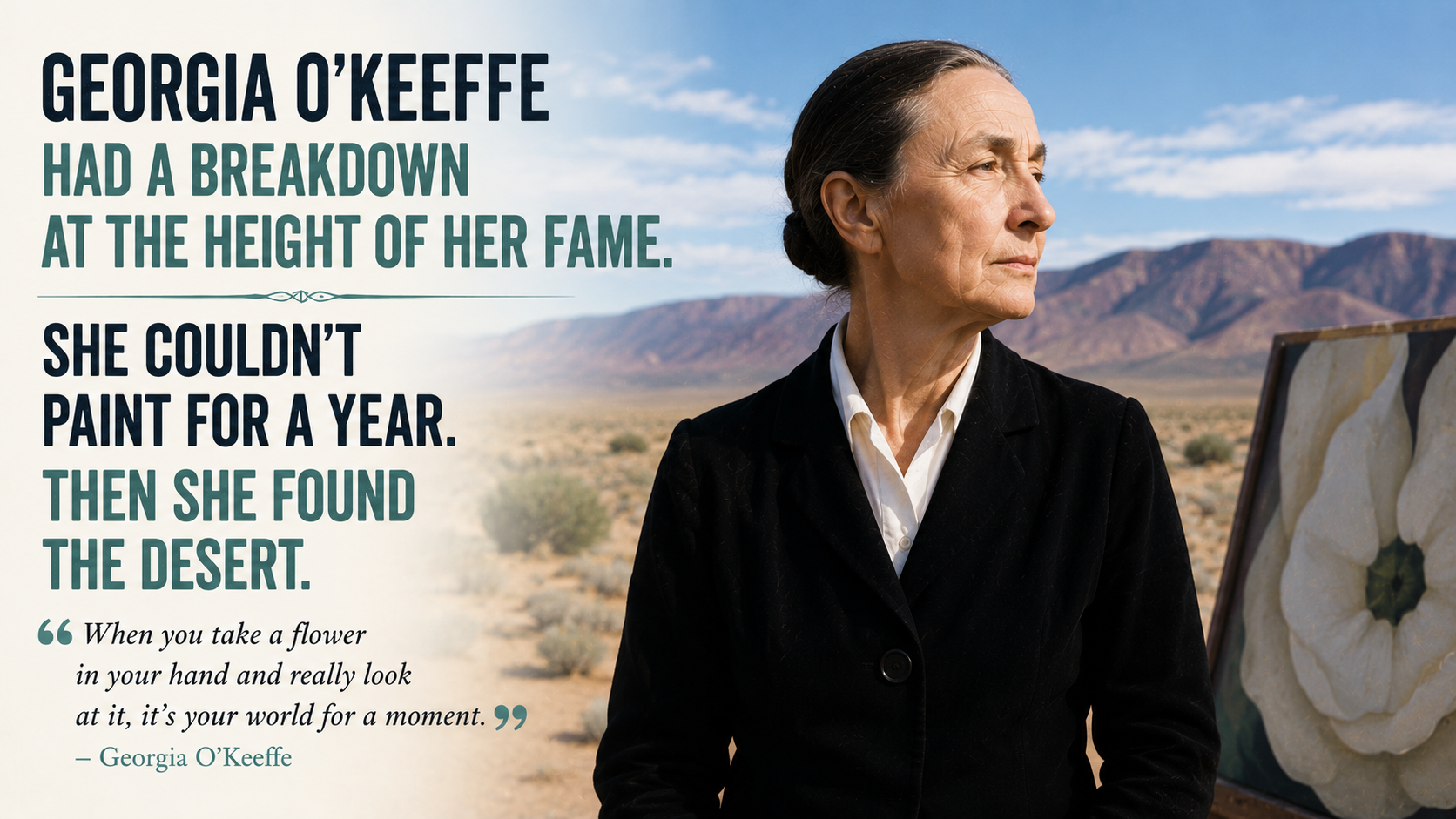
In brief: Georgia O’Keeffe was already one of the most successful painters in America when, in 1932, her life fell apart — a failed commission, a crumbling marriage, and a breakdown so severe she stopped painting completely for close to a year. When she finally picked up a brush again, it was in New Mexico, a landscape that reshaped the rest of her seven-decade career.
What do you do when the thing you’re best at in the entire world suddenly feels impossible?
Not hard. Not challenging. Impossible. Like the door to the one room you’ve always known how to walk into has simply locked itself, and you don’t have the key anymore.
That’s exactly where Georgia O’Keeffe found herself in 1933. And here’s what I find so interesting about her answer — it wasn’t to push through. It was to stop. Completely. And then rebuild her whole life from somewhere else entirely.
She Was Already at the Very Top
By 1932, O’Keeffe wasn’t just a working artist. She was one of the most successful painters in the country. Her calla lily paintings had sold for $25,000 back in 1928 — the highest price ever paid, at that point, for a living American artist’s work. Worth several hundred thousand dollars today. She had exhibitions behind her, a growing legacy, a marriage to Alfred Stieglitz, the influential photographer who’d championed her work since 1917 and helped make her famous. (NJ Mastro)
From the outside, nothing could touch her.
I want to pause on that for a second, because I think we all quietly believe success protects people from falling apart. It doesn’t. It didn’t protect her. And if you’ve ever achieved something you worked hard for and still felt like you were coming apart underneath it — you already understand something true about what’s coming next.
When It All Came Apart at Once
Late 1932. O’Keeffe takes on a major mural commission for Radio City Music Hall, part of the new Rockefeller Center. Huge opportunity. And it goes wrong — technical problems make the project unworkable, and she has to abandon it. (Britannica)
That failure didn’t land in a vacuum. Her marriage was already straining. Stieglitz had disapproved of her taking the commission in the first place, and by this point, he was deeply involved with a much younger woman — a relationship that, by most accounts, wasn’t even a secret within their circle. (Britannica; Artnet News)
A failed project. A public betrayal. All of it landing at once, on someone who had nowhere private left to fall apart.
Early 1933. O’Keeffe has what her contemporaries called, in the language of the time, a “nervous breakdown.” (Britannica)
This Wasn’t a Bad Week
I want to be really clear about the scale of this, because “nervous breakdown” can sound almost quaint from a hundred years away. It wasn’t. She was hospitalized — first at a sanitarium, and when that didn’t help, admitted to a hospital in New York in February 1933. By some accounts, her recovery stretched across as long as two years of moving between hospitalization and rest. (Not Even Past)
Here’s the detail that tells you everything. For an artist whose entire identity was built around an intense, driven relationship with her work — she stopped painting. Not slowed down. Stopped. During her recovery trips to Bermuda in 1933 and 1934, as far as anyone can tell, she didn’t even pick up a pencil. (Artnet News)
Try to actually imagine that. Being the best in the world at the one thing that’s always defined you — and then simply not being able to do it. Not for a week. For the better part of a year.
What would that silence feel like to you, if the thing going quiet was the exact thing you built your whole identity around?
I Have to Be Honest About the Marriage, Too
O’Keeffe’s breakdown can’t really be separated from her marriage, and I don’t think it’s fair to her story to pretend otherwise. She and Stieglitz wrote each other an extraordinary number of letters over the years — something like 25,000, between 1915 and 1946. Real evidence of a deep connection. But he was 59 when they married. She was 36. He managed her career. He controlled much of how the world saw her. Some biographers read her breakdown, at least in part, as a delayed reaction to all of that finally becoming too much to carry. (Psychiatry, Philosophy, Arts; Wikipedia)
That matters, because it means her recovery couldn’t just be about resting until she felt better again. It had to be something bigger. Real distance from the exact life that had helped break her.
The Landscape That Changed Everything
O’Keeffe had actually first visited New Mexico years earlier, starting in 1929 — so the desert wasn’t something she discovered only because of the crisis. But in the fall of 1934, while she was still rebuilding, she visited a remote spot called Ghost Ranch, north of the tiny village of Abiquiu. And something about it took hold of her differently this time. (Britannica)
She started returning every year, often alone, driving the desert roads herself in her Ford Model A, painting straight from the landscape, collecting bones and rocks to bring back to her studio. The work that came out of this — bleached animal skulls, mesas, the stark shapes of adobe buildings against open sky — became what she’s most remembered for today. Completely different from the flowers and city scenes that made her famous in New York. (Artists Network)
She bought a house at Ghost Ranch in 1940, another property in Abiquiu in 1945. After Stieglitz died in 1946, she spent three years in New York settling his estate — and then, in 1949, finally made New Mexico her permanent home. She stayed there the rest of her life. (Wikipedia)
What the Desert Actually Gave Her
I don’t want to make this sound like the desert simply cured her, like flipping a switch. It’s more honest than that. Painting a landscape she’d chosen for herself, far from the marriage and the city that had coincided with her collapse, she rebuilt not just her output, but her entire artistic identity — on terms that were completely her own this time.
She kept painting into her nineties. Seven decades of work, total. In 2014, one of her 1932 paintings — from the very period surrounding her breakdown — sold for $44,405,000 at Sotheby’s. At the time, the highest price ever paid at auction for a work by a female artist. (Wikipedia)
Read that again. The exact period she couldn’t paint through, the paintings that came right after it — that’s the era that eventually became worth more than almost anything else she ever made.
What Her Story Actually Teaches
O’Keeffe’s story doesn’t fit the usual “push through it” advice, because that’s not what she did. She stopped. Completely. For close to a year, one of the most successful painters in America didn’t paint at all — not from a lack of discipline, but because the life she’d built had genuinely become unsustainable, and the only honest thing left to do was stop and rebuild from somewhere new.
What her recovery really shows isn’t the value of powering through. It’s the value of being willing to change your whole life when the one you have has broken you. She didn’t go back to New York and pick up where she left off, painting the same subjects in the same city, next to the same man. She found new ground — literally — and let her work become something different, because she’d had to become someone slightly different too.
So here’s a question worth sitting with, not just skimming past: if the life you’re trying to rebuild looks exactly like the one that broke you, is rebuilding really what you need? Or do you need your own version of the desert — somewhere far enough away that you can actually become something new?
I can’t answer that for you. But I don’t think O’Keeffe could have answered it for herself either, until she actually went looking. Never give up.
Frequently Asked Questions
Why did Georgia O’Keeffe stop painting in 1933?
She had a severe breakdown after a failed mural commission and serious strain in her marriage to Alfred Stieglitz. She was hospitalized and didn’t paint again for close to a year. (Britannica)
How did she recover?
She rested partly in Bermuda in 1933 and 1934, then began returning to New Mexico, discovering Ghost Ranch in fall 1934 — a place that reshaped the rest of her life and work. (Artnet News)
When did she move to New Mexico permanently?
In 1949, three years after Stieglitz’s death, and she lived there for the rest of her life until her death in 1986. (Wikipedia)
What is her most valuable painting?
Jimson Weed/White Flower No. 1 (1932), which sold for $44,405,000 in 2014 — the highest price ever paid at auction for a work by a female artist. (Wikipedia)
If the life you’re rebuilding still looks like the one that broke you, talk to Risha — your AI friend, here any time you need help thinking through what might need to change.
Get a story like this every week: Join the Project Never Give Up newsletter — it’s free.