In brief: Research in psychology and behavioural science consistently shows that people most often quit not at the beginning, when things are hardest, but at the point just before a breakthrough — when effort has peaked but results haven’t arrived yet. Understanding why this happens is the first step to making sure it doesn’t happen to you.
A study by researchers at Columbia University found that the point at which people are most likely to give up on a long-term goal is not at the beginning. It is at the midpoint — when they have already invested significant effort, when results are still not visible, and when the gap between where they started and where they want to be feels at its largest. (Koo & Fishbach, 2012)
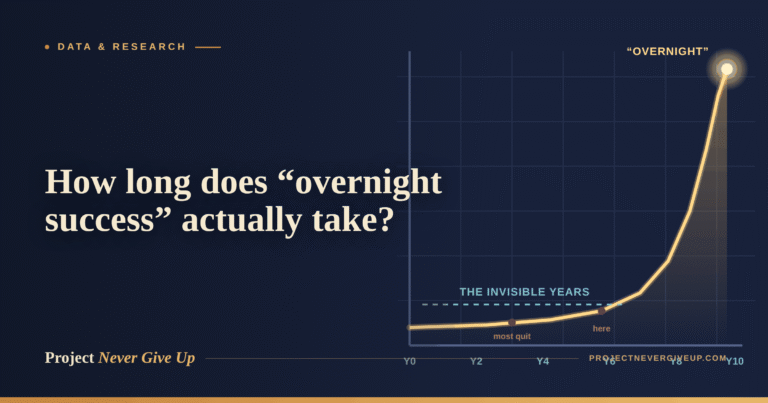
The midpoint is when the gap is most visible and the reward is least visible. It is the place where most intelligent, hardworking, committed people quietly stop. Not because they run out of ability. Because they run out of signal.
The Problem Isn’t Laziness. It’s Information.
The people who give up before the breakthrough are, disproportionately, people who work extremely hard. What they lack is not effort — it is feedback. The kind of visible, tangible feedback that tells them their effort is building toward something.
Psychologists call this the progress principle. Teresa Amabile and Steven Kramer at Harvard found that of all the things that boost performance and wellbeing, the single most powerful is making progress in meaningful work — even small progress — and being able to see it. (Harvard Business Review) When progress is invisible, motivation collapses. And in the middle of most long-term pursuits, progress is invisible — because what’s happening is underground. Skill building. Reputation building. Things that compound slowly and reveal themselves suddenly.
The Dip — And Why It Fools Smart People Most
In 2007, Seth Godin named something most people intuitively know: in almost every meaningful pursuit, there is a period after the initial excitement fades and before results arrive where progress appears to stop entirely. He called it the Dip. (Seth Godin)
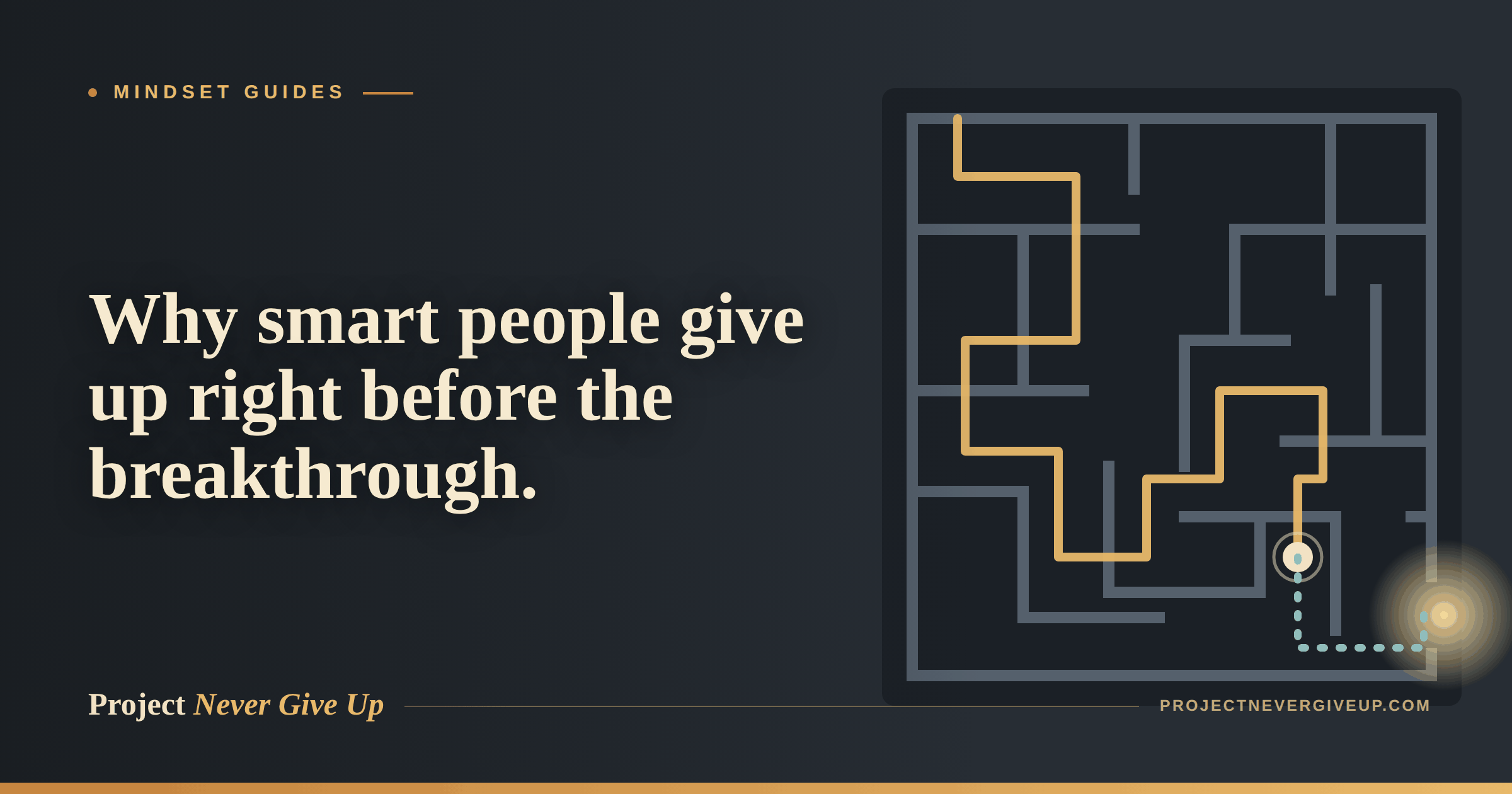
The Dip is not a sign you’re going the wrong way. It’s the filter that makes the reward on the other side scarce and valuable. Here’s what makes intelligent people particularly vulnerable: they are better than most at constructing rational-sounding reasons to stop. “The market has changed.” “The timing isn’t right.” “I’ll apply what I learned to the next thing.” All can be true. Any can also be the Dip in disguise — dressed up as strategy to make stopping feel like wisdom rather than exhaustion.
The Four Real Reasons Smart People Give Up Too Early
1. They Measure Results, Not Progress
Results are binary and delayed. Progress is continuous — but you have to know what to measure. Build a parallel system of process metrics you can actually see moving: pages written, conversations started, skills sharpened. When you track them, the days that feel like nothing are revealed to be days when something happened.
2. They Compare Their Chapter Three to Someone Else’s Chapter Twenty
The most accomplished people in any field are the most visible — and visible at their peak, not their beginning. J.K. Rowling had no idea, in that Edinburgh café, that any of it would work. Steve Jobs had no idea, during his wilderness years, that he was building toward the iPhone. The external view of success always looks shorter than the lived experience.
3. They Mistake Exhaustion for Evidence
When you are tired and depleted, setbacks feel permanent and obstacles insurmountable. This is a documented feature of how the exhausted brain processes negative information. (NIH) If you are exhausted and considering giving up, the first intervention is not strategic. It is rest. Take a week before you decide anything that can’t be undone.
4. They Lose Touch With Why They Started
In the grind of the middle, the original why gets buried under logistics and setbacks. The people who make it through the Dip almost universally have a why bigger than “I want to succeed” — connected to a person they want to serve, a change they want to make. That kind of why provides fuel that pure ambition can’t match.
How Not To Give Up Before the Breakthrough
Track process, not just outcomes. Build a record of what you actually did — not the results, but the doing. Set a decision date. Pick a date three or six months away and commit to continuing until then. Find someone who’s been through the Dip — for recognition that the feeling you’re having is not evidence of failure. Reconnect with the why — the version that was true the day you started, before anyone else had an opinion.
The Brutal Truth
Some pursuits genuinely should be abandoned. Not every Dip is worth pushing through. The key question is not “how do I feel?” — because in the Dip, you feel terrible, and that’s not useful information. The key question is: “Is there any real evidence this is building toward something?” If the evidence says yes — if there are signs, however small — then what you’re experiencing is the Dip, not a verdict. Stay in it. The breakthrough is on the other side of the thing currently making you want to stop. Never give up.
Frequently Asked Questions
Why do people give up when they’re close to success?
Primarily because progress becomes invisible at the midpoint. Without visible feedback, the brain interprets sustained effort as evidence the goal is unreachable, rather than as evidence a breakthrough is building. (HBR)
How do I know if I’m giving up too soon?
Ask whether there is real evidence — external signals, not feelings — that what you’re doing has value. If yes, you’re likely in the Dip, not at a dead end.
Is it ever right to give up?
Yes. The goal is to quit strategically rather than emotionally. Quitting an approach or timeline is often right. Quitting a deep purpose because of a hard stretch is almost never right.
What’s the best thing to do when you feel like giving up?
If exhausted: rest before deciding. If clear-headed: reconnect with the why, track what’s moving, and set a decision date rather than deciding in a temporary state.
If you need someone to think this through with, Risha is here — any time.
Get this kind of content every week: Join the Project Never Give Up newsletter — it’s free.