We live in a culture obsessed with early success.
The twenty-something founder. The prodigy. The overnight sensation. Every week there’s a new list of people who achieved something remarkable before they were thirty — and if you’re reading this past that age, a small voice can wonder if the window is closing. If it’s too late.
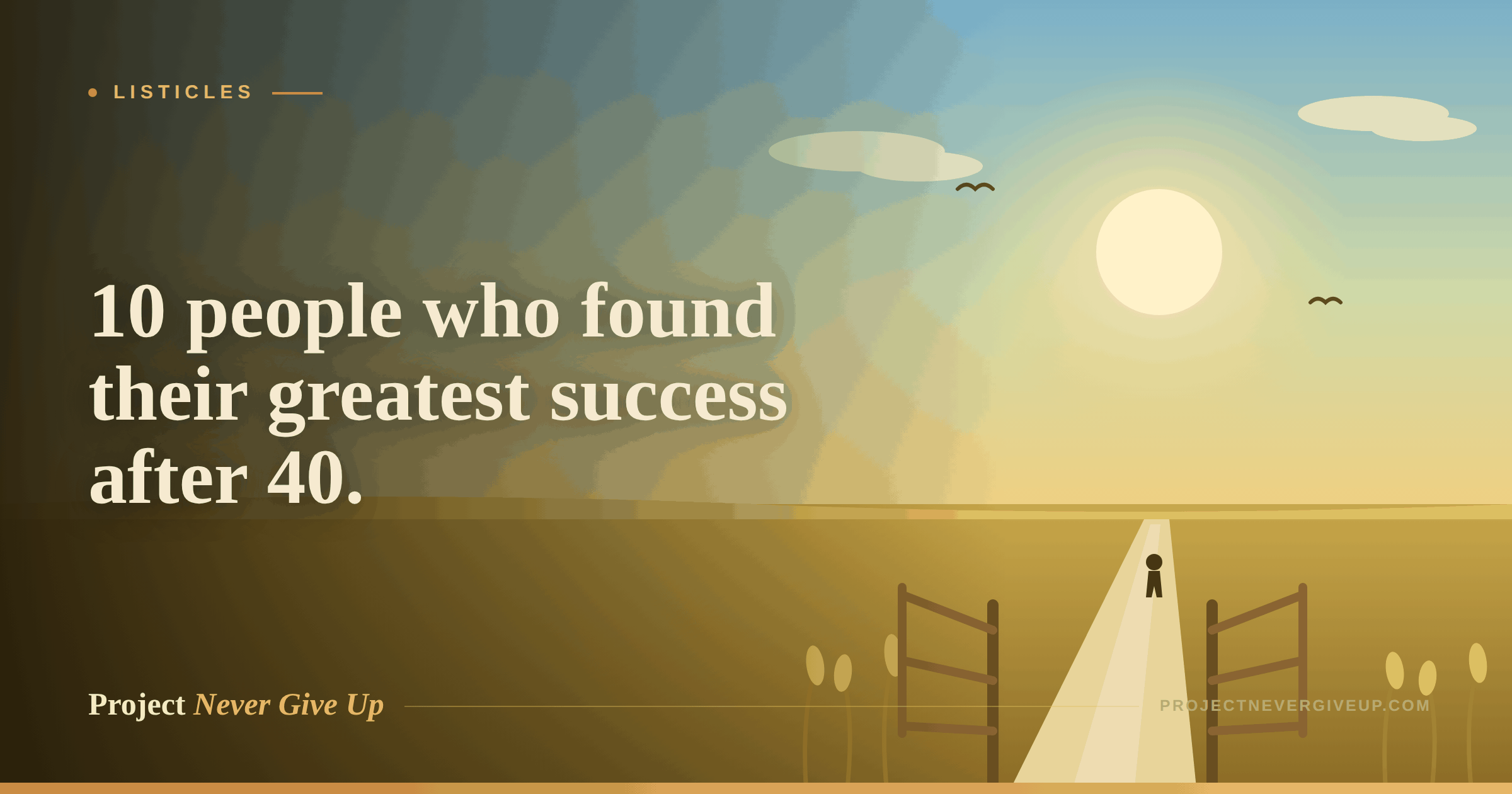
It isn’t. And the following ten people are proof — documented, factual proof that some of the most significant things human beings have ever built were built by people still finding their footing at forty, fifty, and beyond.
1. Colonel Harland Sanders — Started KFC at 65
When Sanders was 65, a new highway destroyed the restaurant he’d spent twenty-five years building. His Social Security cheque arrived: $105 a month. He put his recipe in a bag, got in his car, and was rejected 1,009 times before anyone said yes. Today there are over 27,000 KFC locations in 145 countries. (Wikipedia) What he did differently: he had evidence. When he knocked on those doors, he wasn’t hoping — he was certain.
2. Julia Child — Published Her First Book at 49
Julia Child didn’t learn to cook properly until her late thirties. Mastering the Art of French Cooking was published in 1961, when she was 49, after nearly a decade of rejections. It transformed American cooking. (Britannica) What she did differently: she chose mastery over speed.
3. Ray Kroc — Built McDonald’s Into a Global Empire at 52
Kroc spent most of his life as a milkshake machine salesman. At 52, he franchised a small California burger restaurant. Today McDonald’s has over 40,000 locations. (Britannica) What he did differently: he recognised an opportunity that required thirty years of experience to see.
4. Vera Wang — Entered the Fashion Industry at 40
Wang spent fifteen years as a figure skater, then fifteen more as a Vogue editor. At 40, unable to find a wedding dress she liked, she designed her own and opened a bridal boutique. (Biography.com) What she did differently: she didn’t research a market gap — she was the market gap.
5. Toni Morrison — First Novel at 39, Nobel Prize at 62
Morrison spent her twenties and thirties as a single mother, writing her first novel in the early mornings before her children woke. The Bluest Eye was published in 1970. In 1993, at 62, she received the Nobel Prize in Literature. (Nobel Prize) What she did differently: she wrote in the margins of a life that was already full.
6. Stan Lee — Created Marvel’s Most Iconic Characters at 39
Lee spent nearly twenty years writing comics when, at 39, he created the Fantastic Four. Spider-Man, the X-Men, Iron Man, Thor, and the Avengers followed. (Britannica) What he did differently: the iconic characters came from two decades of work that looked, from outside, like nothing special.
7. Charles Darwin — Published On the Origin of Species at 50
Darwin returned from the HMS Beagle in 1836 and spent twenty-three years gathering evidence before publishing in 1859, at 50. All 1,250 copies of the first edition sold on the day of publication. (Britannica) What he did differently: he was willing to wait until he was right.
8. Grandma Moses — Started Painting at 78
Anna Mary Robertson Moses spent most of her life as a farm wife. At 78, arthritis ended her embroidery, so she picked up a paintbrush. She painted over 1,500 works and was on the cover of Time at 101. (MoMA) What she did differently: she started. That’s the whole story. She started.
9. Amitabh Bachchan — Came Back From Bankruptcy at 56
By the mid-1990s, Bachchan’s production company had collapsed into bankruptcy. At 56, he returned to television as host of Kaun Banega Crorepati, which became the highest-rated programme in Indian television history. (Britannica) What he did differently: he was willing to be a beginner again in public.
10. Harry Bernstein — Published His First Book at 96
Bernstein spent decades receiving rejections. At 96, his memoir The Invisible Wall was published and became an international bestseller. He published three more before his death at 101. (The Guardian) What he did differently: he just kept writing. He was still there when the right book found the right moment.
What All Ten Have in Common
None of them were waiting to start. They were all already doing the work — building skill, gathering evidence, showing up — long before the breakthrough arrived. The breakthrough didn’t happen because they started. It happened because they had never stopped.
Your timeline is not behind. It’s just yours. Keep going. Never give up.
Frequently Asked Questions
Is it really possible to start over after 40?
Not only possible — often advantageous. Many of these people succeeded specifically because of the experience, perspective, and resilience that only comes from decades of challenge.
What’s the most common reason people give up before finding late success?
Comparison to others’ timelines — the belief that because success hasn’t arrived by a culturally determined deadline, it’s no longer coming. The people in this list ignored those timelines.
How do I know if I’m still on the right path?
Ask: am I still doing this because I believe in it, or because I’ve invested too much to stop? The first is a reason to continue. The second is worth examining honestly.
Inspired by these stories? Risha is here to help you work through where you are.
Want more stories like this every week? Join the Project Never Give Up newsletter — it’s free.