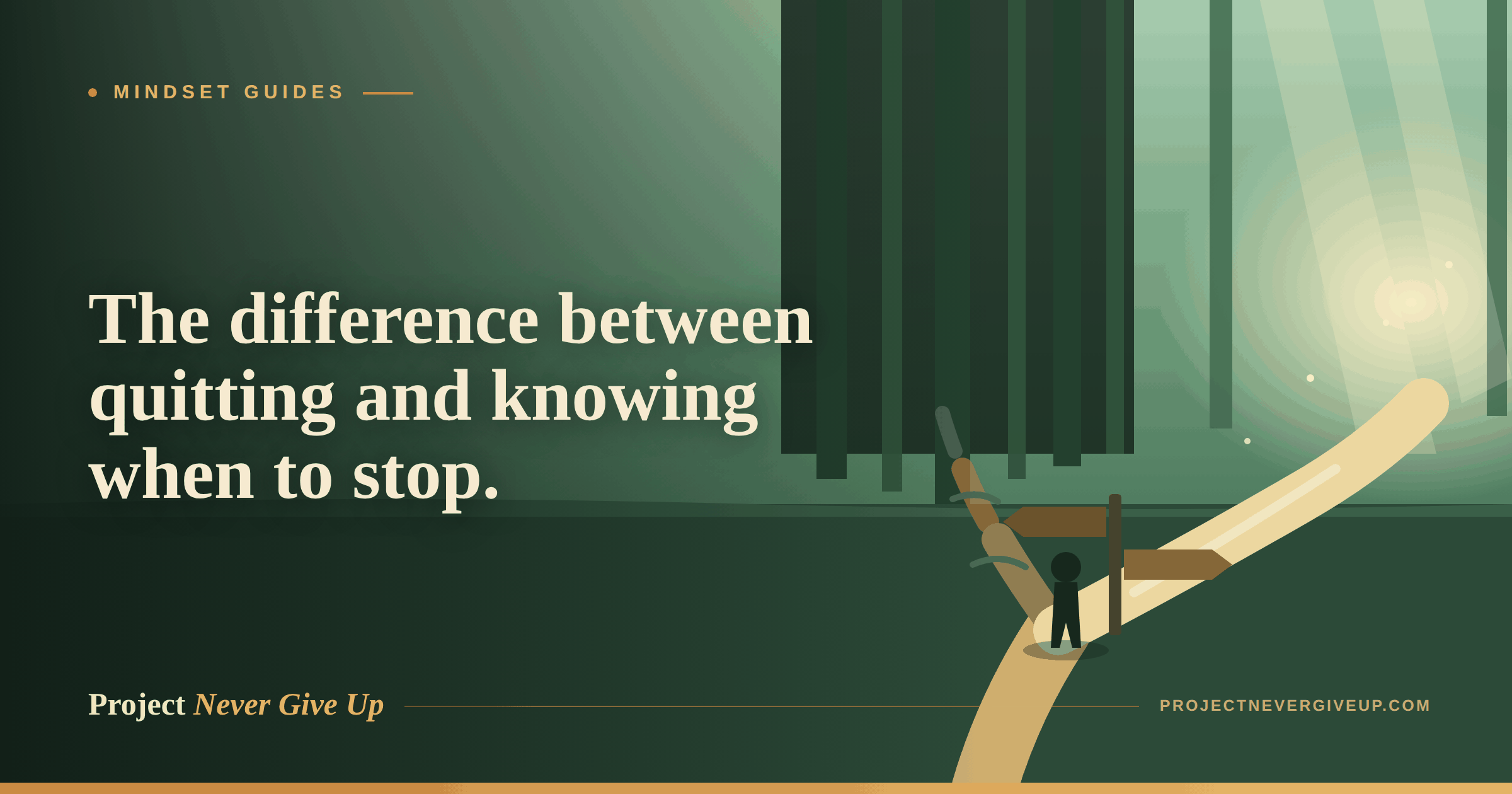
In brief: “Never give up” is powerful advice — but it is incomplete. There is a meaningful difference between quitting because something is hard and stopping because something is genuinely wrong. Understanding that difference is one of the most valuable things you can learn. This article explains how to tell them apart.
This might be the most honest thing we’ve written on this site. Project Never Give Up exists to remind people that most things worth doing are hard, and that the difficult middle is not a reason to stop. That is true. But here is something equally true: sometimes stopping is the right decision. Sometimes what looks like perseverance is actually just fear of change dressed up in the language of commitment. The question is: how do you know which is which?
First, What Quitting Actually Is
Quitting is making a permanent decision based on a temporary state. It feels like relief in the moment, followed quickly by a hollow feeling. It tends to happen at a low point rather than after calm reflection. And it forecloses options rather than opening them.
Seth Godin puts it this way: “Quitting as a short-term solution to a long-term problem is a bad idea. Quitting a dead end — quitting a path that has no good outcome — is often the smartest thing you can do.” (Seth Godin) The distinction between a hard stretch and a dead end is the whole game.
Three Questions Worth Sitting With
Question 1: Am I stopping because of evidence or because of feelings?
Feelings are real, but they are not evidence. Evidence is: Has anyone ever genuinely responded to what you’re doing? Is there any signal — however small — that this has value? If the honest answer involves even one small yes, you are probably dealing with feelings, not evidence. Feelings change. Evidence is where decisions should be grounded.
Question 2: Am I stopping the goal or a specific path?
Walt Disney didn’t give up on animation when Laugh-O-Gram went bankrupt — he gave up on that company. Colonel Sanders didn’t give up on his recipe when the restaurant closed — he tried franchising. Steve Jobs didn’t give up on technology when fired from Apple — he built NeXT and Pixar. In each case the goal stayed constant. The path changed. Changing the path is not giving up — it is strategic adaptation.
Question 3: What would I do if this weren’t an option?
If removing the exit reveals a person who would “find another way,” you don’t want to stop — you want a better route. If the honest answer is “I would feel relieved,” that’s also important information. Relief at the prospect of stopping is sometimes a sign of honesty about a path that genuinely was wrong.
The Cases Where Stopping Is Right
When the path is harmful to your health, relationships, or wellbeing in ways that are not temporary. No goal is worth your health. When new information has genuinely changed the picture — real, specific, external information, not fear presenting as information. When the goal was never really yours — chosen to satisfy a parent, match a peer, or avoid the feeling of failure. When you have genuinely tried multiple fundamentally different approaches over a meaningful period and none produced any signal.
The Cases Where Stopping Is Wrong
When you are exhausted. Exhaustion makes permanent what is temporary. Rest before deciding. When you just had a significant setback. The day after a failure is not the day to make permanent decisions. When you’re comparing your progress to someone else’s outcome. That’s a comparison problem, not a decision problem. When you haven’t actually asked for help. Many people who give up never asked for the specific help that might have changed the outcome.
The Real Definition of Never Give Up
“Never give up” is not a command to keep doing the same thing forever regardless of evidence. It means: never give up on who you are trying to become. Never give up on the contribution you are trying to make. Never let a temporary state become a permanent decision about a permanent thing.
Change the path when the path needs changing. Rest when rest is needed. Ask for help. Adapt. But don’t close the door on the thing that matters to you because a hard stretch has made everything feel impossible. The hard stretch is not the evidence. It is the test. Pass it.
Frequently Asked Questions
How do I know if I should quit or keep going?
Ask whether your decision is based on evidence or feelings. Evidence is a reliable basis. Feelings generated by exhaustion, comparison, or recent setbacks are not.
Is giving up ever the right thing to do?
Yes — when the path is genuinely harmful, when the goal was never really yours, or when real new information has changed the picture. The key is deciding from clarity, not from a low moment.
What’s the difference between quitting and pivoting?
Quitting closes a goal. Pivoting changes the path while keeping the goal intact. Disney pivoted from Laugh-O-Gram to the Disney Brothers’ Studio — he didn’t give up on animation.
What should I do if I feel like giving up right now?
Rest if exhausted, before deciding. Separate the goal from the path. Look at the evidence, not the feelings. And if you need someone to think it through with, Risha is here.
Need to talk this through? Risha is available any time — no judgment, no agenda.
Want honest, practical content like this weekly? Join the Project Never Give Up newsletter — it’s free.