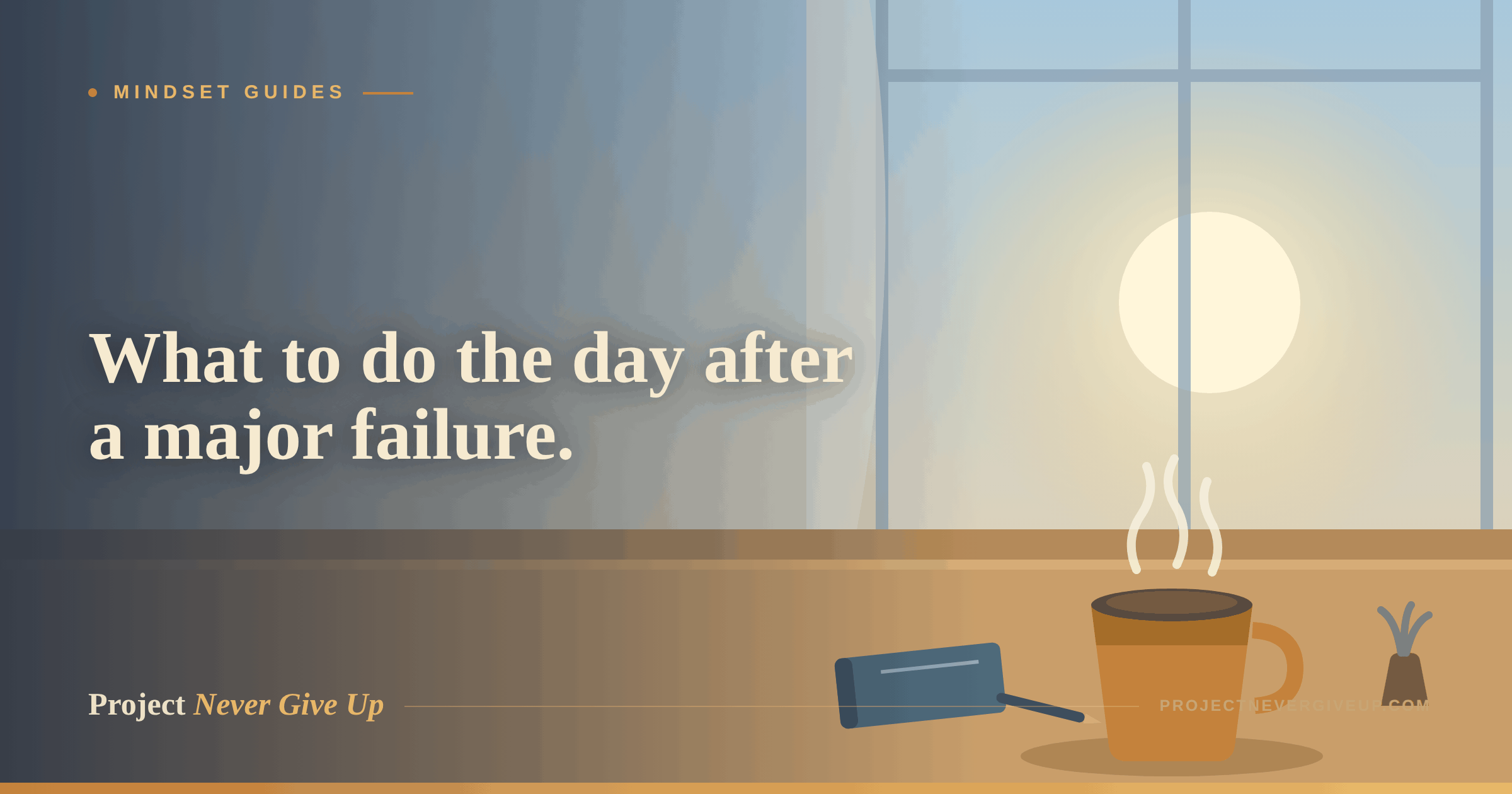
In brief: The day after a significant failure — a job loss, a rejection, a business collapse, a relationship ending, a project that didn’t work — is one of the most practically important days in your recovery. Most advice skips straight to long-term resilience strategies. This guide covers the actual hours: what to do, what not to do, and why the first 24 hours matter more than most people realise.
Nobody writes about the day after. There is plenty of content about resilience and long-term recovery, but almost nothing about the specific, practical reality of waking up the morning after something went badly wrong — the heaviness of it, the disorientation, the question of what you are supposed to do with the next twelve hours. This guide is for that morning. For the next twenty-four hours specifically. No grand reframes. Just specific things that help, hour by hour, on one of the harder days you will have.
The First Hour: Do Not Make Any Decisions
The most important thing you can do in the first hour is make no significant decisions. This is not avoidance — it is strategy. Research shows the quality of decisions made in acute distress is significantly lower, not because you’re less intelligent, but because the emotional centres of the brain are consuming cognitive resources that would otherwise be available for clear thinking. (APA)
The urge to act immediately — send the email, make the call, announce the pivot — is strong. Resist it. The decision will still be there in two hours, in a better state to make it. The exception is genuine emergency. What to do instead: Make coffee. Eat something. Sit with it. The discomfort of sitting with it is not the same as the disaster of acting prematurely from it.
Hours Two and Three: Move Your Body
Physical movement is one of the most robustly evidenced interventions for acute emotional distress — not because it solves the problem, but because it changes the physiological state from which you experience it. Exercise reduces cortisol and increases serotonin and dopamine. Even thirty minutes of moderate activity produces measurable changes in how the brain processes negative information. (NIH)
What to do: Go outside if you can. Move for at least 30 minutes. Don’t listen to anything that amplifies the feeling. Just move and let your mind process without directing it.
Hours Three to Five: Talk to One Person — the Right One
The type of social support matters more than whether you receive it. The wrong kind — someone who jumps to solutions, minimises (“at least…”), or panics alongside you — can amplify distress. What you’re looking for is co-regulation: someone whose calm, steady presence helps regulate your nervous system, who can hold the situation with you without minimising or catastrophising. (Greater Good Science Center)
One person. The right one. Not a group. Not social media. If that person doesn’t exist right now, Risha is here. What to say: “I’m not doing well today and I just need someone to talk to” is a complete and sufficient thing to say.
Mid-Day: The Factual Account
At some point mid-day, write down a factual account of what happened. Not how you feel. Just the facts. This comes from cognitive behavioural therapy, where it’s used to separate the event from the interpretation of the event. Write: what happened, specifically. Not “I failed” — that’s an interpretation. The fact is: the interview didn’t lead to an offer. The pitch was declined. Then, separately, write what you feel about it — give the feelings their own space, away from the facts. (Psychology Today)
Afternoon: Protect the Basics
Eat real food — a depleted body amplifies every negative emotion. Drink water; even mild dehydration worsens mood and working memory. (NIH) Limit alcohol — a practical note, not a moral one: it reliably worsens mood and sleep the following day. Do one small, normal thing — make your bed, cook something simple. Behavioural activation shows that doing ordinary things from a disrupted state helps restore the sense of agency that failure temporarily removes. (Psychology Today)
Evening: One Question, Not Many
By evening there will be pressure to figure out what comes next. Don’t do all of that tonight. Allow yourself one question: Is there anything that needs to happen in the next 48 hours that won’t wait? If yes, write it down and address it tomorrow morning. If no, let tonight be tonight. You will not solve this tonight. You are not supposed to. Tonight’s job is to get to tomorrow.
Sleep: The Most Important Thing You Will Do Today
Sleep is when the brain consolidates emotional memories — stripping the emotional charge while retaining the factual content. This is the mechanism by which “sleeping on it” actually works. (Nature Reviews Neuroscience) If sleep is difficult: cool the room, avoid screens for an hour before bed, write down anything still circling in your head, and don’t lie there trying to think your way through the problem. (Sleep Foundation)
What Tomorrow Is For
Tomorrow is when you start to assess what actually happened and what comes next. Not tonight. Every person who has ever built something significant has had their own version of this day. Walt Disney had it when Laugh-O-Gram went bankrupt. J.K. Rowling had it when another publisher rejected the manuscript. Michael Jordan had it after the Pistons eliminated the Bulls for the third straight year. They all got through the day after. Then the one after that. Then, eventually, something changed. Your job today is simple: get to tomorrow. You can do that. Never give up.
Frequently Asked Questions
Why is the day after failure so hard?
Because acute failure activates the same threat response as physical danger — elevating cortisol, narrowing cognitive function, amplifying negative emotion. The day after is often when this peaks, as the initial shock passes and the full reality is present. This is normal and temporary. (APA)
Should I talk about what happened right away?
With one trusted person, yes — ideally someone calming rather than activating. Avoid processing in groups or on social media. The goal is co-regulation, not co-catastrophising.
When should I start planning my next steps?
Not today, unless something genuinely cannot wait. Most things that feel urgent the day after a failure are not urgent on the timescale that matters for recovery. Give yourself at least 48 hours before significant decisions.
Is it okay to not be productive on the day after a failure?
Not only okay — appropriate. The most useful things you can do (eat, move, sleep, talk to one person) don’t look productive. They build the foundation from which productivity eventually returns.
If you’re in the day after right now and need someone to talk to, Risha is here — any time, no judgment.
Want practical resilience tools every week? Join the Project Never Give Up newsletter — it’s free.