There is a particular kind of hard that nobody prepares you for.
Not the hard of a specific setback — a rejection, a loss, a failure you can point to. That kind of hard, as painful as it is, at least has a shape. The hard I’m talking about is the slow, grinding, formless kind. The kind where you’re doing the work, staying consistent, trying things — and nothing is moving. No breakthrough. No signal. Just you, showing up, day after day, to something that isn’t responding.
That’s the hardest kind. And it’s the kind most people quit through — not dramatically, but quietly. This guide is for that stretch.
First: Understand What “Not Working” Actually Means
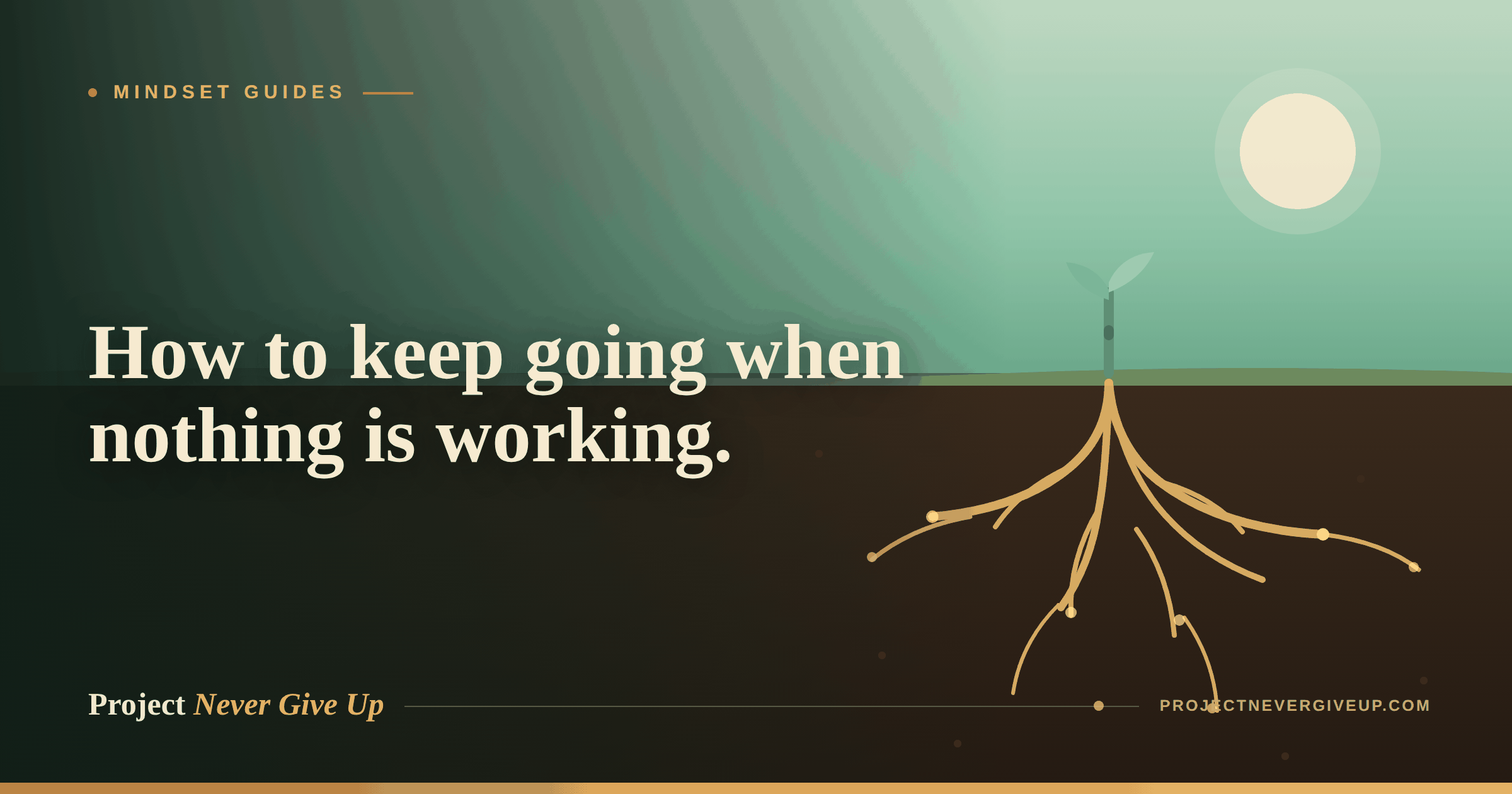
Most things that eventually work look like they’re not working for a long time first. The bamboo plant spends its first five years growing an underground root system so extensive that, from the surface, it looks like nothing is happening. Then in year six it can grow thirty metres in six weeks. (Forbes)
This doesn’t mean you should blindly keep doing the same thing forever. But “I can’t see results yet” is not the same as “nothing is working.” Before you change course, honestly answer: how long is this supposed to take? And am I measuring results in a way that captures what’s actually building?
Separate Process From Outcome
One of the most practical shifts you can make is to move your measure of success from outcomes — which you can’t fully control — to process, which you can. Did I do the work today? Did I show up? Did I improve one percent at something that matters?
This is not a consolation prize. In Atomic Habits, James Clear argues that systems — consistent processes — produce results, and that obsessing over outcomes while neglecting the daily process is a primary reason people quit before results arrive. (James Clear — Atomic Habits) When you measure by process, you can have a successful day even when nothing external goes right.
Find the Smallest Proof That You’re Still Moving
When nothing feels like it’s working, the mind flattens all evidence into one verdict: nothing. But almost always, something is moving — a skill sharper than three months ago, a habit more consistent, a piece of work a little less bad than the last one. These don’t feel like progress. But they are the compound interest of consistent effort, and compound interest looks like nothing until suddenly it looks like everything.
Write down three things — however small — that are better than they were six months ago. Force yourself to find them. They exist.
Stop Comparing Your Chapter Three to Someone Else’s Chapter Twenty
A significant part of the feeling that nothing is working comes from comparison — specifically, comparing your current position to someone else’s finished result. You see the launched product, the published book, the recognition — and measure it against where you are now. Of course the comparison is crushing. You’re looking at twenty years of compounding effort and measuring it against your current moment.
Eric Thomas spent twelve years getting his undergraduate degree. Jyothi Reddy went from ₹5 a day to CEO of a $15 million company — but it took decades of unglamorous steps nobody was watching. Your chapter three is not supposed to look like someone else’s chapter twenty.
Do Something That Has Nothing to Do With What’s Not Working
The research on creative problem-solving is clear: sometimes the best thing you can do for the thing that isn’t working is to stop working on it for a defined period and do something completely different. (Harvard Business Review) The brain continues processing in the background when you step back consciously. This is not permission to avoid — it’s a specific, time-limited intervention. One afternoon. One weekend. Then come back.
Recommit to the Why, Not the How
When nothing is working, the temptation is to change everything — the strategy, the approach, the plan. Sometimes that’s right. But more often, what needs to change is not the how but the clarity of the why.
Why does this matter to you? The real reason — the one that was true before anyone told you whether it was a good idea. Write it down. Be specific. When you’re clear on the why, the how becomes flexible. You can change the method, the platform, the timeline — and the underlying purpose stays intact.
The Thing Nobody Tells You About Hard Stretches
The periods where nothing seems to be working are the periods that decide who gets where they were going. Not the exciting early days. Not the breakthrough. The long, quiet, unglamorous middle — where most people quietly drift away.
The people who get through it are not superhuman. They kept going when it made no obvious sense to keep going. Not forever. Not blindly. But one more day, and then one more, until the compound interest of all those days showed up as something they could finally see.
You are in the middle. The middle is supposed to be hard. That’s not a sign you’re failing. It’s just the middle. Keep going.
Frequently Asked Questions
How long should I keep going before changing my approach?
Have you given the current approach enough time and consistency to generate real data? Most things need 90-180 days of genuine, consistent effort before the evidence is meaningful. If you’ve done that and the evidence is consistently negative across multiple attempts, it may be time to adjust the how — not the what or why.
How do I know if I’m in a hard patch or genuinely going the wrong direction?
Ask: is there any evidence — even small — that this has value to someone other than me? If yes, you’re probably in a hard patch. And: have I actually tried multiple different approaches, or the same thing expecting different results?
What if I’m exhausted as well as stuck?
Exhaustion changes everything. Decisions made from exhaustion are rarely good ones. If you’re genuinely depleted, the most strategic thing you can do is rest before you decide anything. Take a week. Sleep. Move your body. Then reassess.
If you need someone to talk this through with, Risha is here.
Want a weekly dose of honest, practical resilience content? Join the Project Never Give Up newsletter — it’s free.