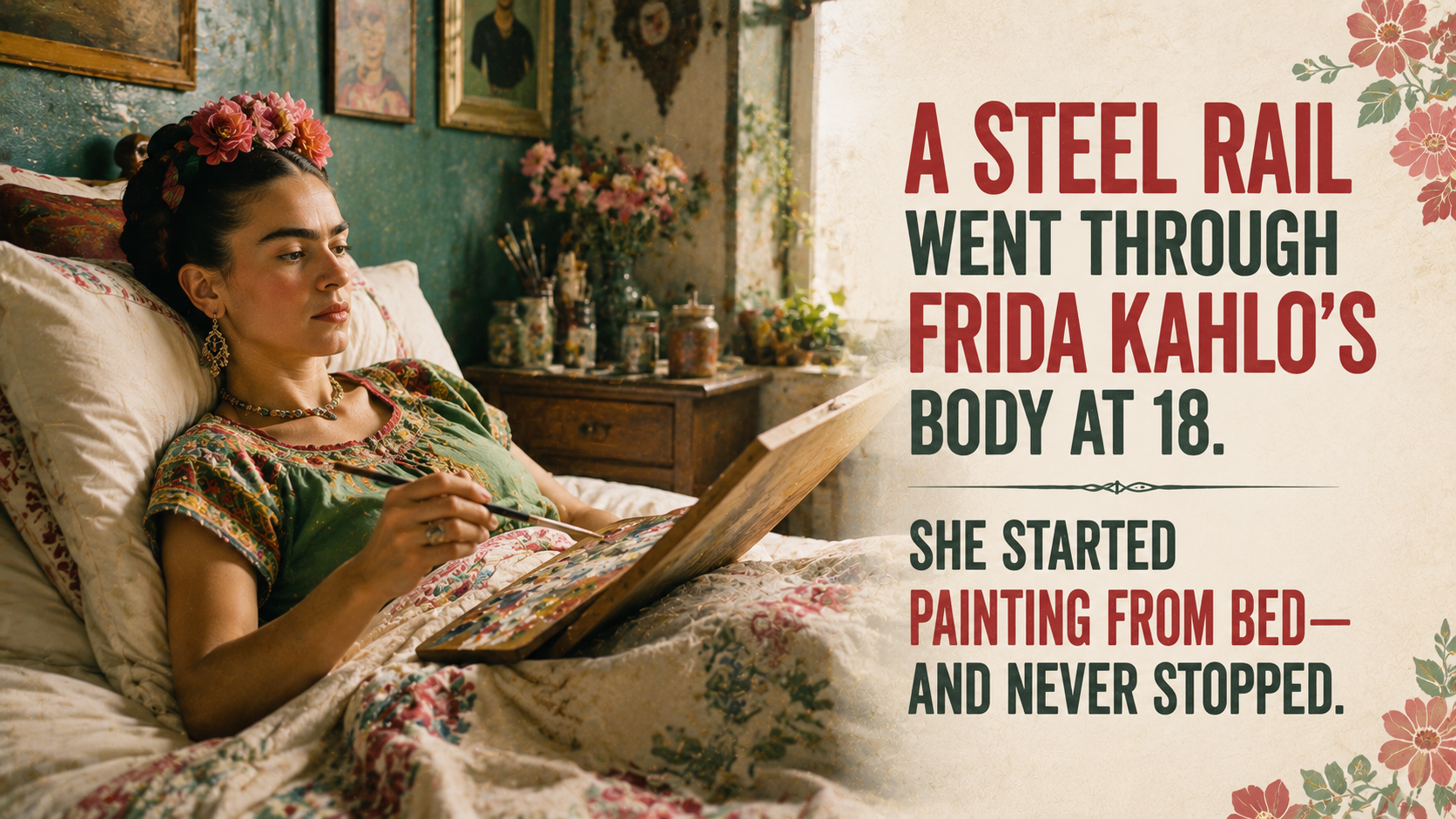
In brief: At 18, Frida Kahlo was riding a bus that collided with a trolley car. A steel handrail tore through her body. Doctors weren’t sure she’d survive. Months into a full-body cast, bored and in constant pain, she asked her mother for a special easel and a mirror above her bed — and started painting herself, because she was the only subject always available. She never really stopped.
Can I ask you something? What’s the thing you were planning to become, before something happened that took that plan away completely?
Frida Kahlo was 18, on a pre-medical track, working toward becoming a doctor. Then one ordinary afternoon ended that plan permanently. What she built instead is the thing she’s actually remembered for.
The Accident
September 17, 1925. Kahlo boarded a wooden bus in Mexico City with her boyfriend, heading home from school. Minutes later, the bus turned a corner directly into the path of an oncoming trolley car. She described the impact to her biographer, years later, as strange — “not violent but dull and slow.” It was not slow in its consequences. (History.com)
A steel handrail from the bus tore through her body — in at the hip, out through the pelvis. Her spine broke in three places. Her collarbone, several ribs, her pelvis, all fractured. Her right leg broke in eleven places. Doctors at the scene didn’t expect her to survive the trip to the hospital, let alone the surgery after. (Kahlo.org)
Try to actually picture that moment — not as a fact on a page, but as something happening to an 18-year-old on an ordinary afternoon, on her way home from school.
She Survived. Then What?
She survived. What was supposed to happen next was recovery — eventually returning to the life she’d already planned. Kahlo had been a top student, working toward medical school, aiming to become a doctor. That plan ended in the wreckage. (Biography.com)
She spent a month in the hospital, then went home in a full plaster body cast, confined to bed for months, mostly alone, in near-constant pain.
What do you actually do with that kind of stillness? Not a metaphorical pause — a literal one, where your body won’t let you move, and the future you’d already mapped out is simply gone.
The Mirror Above the Bed
She’d sketched before, casually, alongside her photographer father. But it was in that bed, immobilized, bored past the point of enduring it, that painting became something else entirely.
Her mother had a special easel built that could be used lying flat, and fixed a mirror to the underside of the canopy above her bed. Kahlo put it plainly, years later: “I was bored as hell in bed with a plaster cast… I stoled from my father some oil paints, and my mother ordered for me a special easel because I couldn’t sit down, and I started to paint.” (Lisa’s History Room)
The mirror wasn’t an artistic choice, not at first. It was practical. She had almost no other subject available. Confined, largely isolated, she became — out of necessity, not ambition — her own primary subject. And that constraint became the foundation of everything she’d eventually be known for.
It Never Really Ended
Here’s what I think gets missed most in her story: the damage from that accident never fully resolved. She had more than thirty additional surgeries over the rest of her life, including operations where surgeons re-broke and re-set her spine. “I hold the record for operations,” she said in 1951, after a single year that included nine of them, seven on her spine alone. (Artforum)
She wasn’t injured once and then painted her way past it. She was injured for the rest of her life, and painting was how she stayed inside that life instead of being erased by it.
She even painted directly onto the medical corset she was forced to wear — turned a piece of orthopedic equipment into another self-portrait. Because why would she wait for the pain to end before she made something out of it? (Google Arts & Culture)
What I Actually Want You to Take From This
Kahlo’s story doesn’t fit neatly into “she overcame it.” She didn’t overcome it — the pain never left. What she did instead was refuse to treat the pain as something to hide until real life could resume. She made the pain the material.
That’s a different, harder question than the one most comeback stories ask. It’s not “how do I get back to normal.” It’s “what can I actually make, right now, from inside the thing I can’t escape?”
So let me ask you that directly. Is there something in your life right now that isn’t going away — a diagnosis, a grief, a limitation that isn’t temporary, no matter how much you want it to be? What would it look like to stop waiting for it to end before you start building something? Not despite it. From inside it. Never give up.
Frequently Asked Questions
How did Frida Kahlo’s accident happen?
On September 17, 1925, the bus she was riding in Mexico City collided with an electric trolley car. A steel handrail impaled her body, and she suffered fractures to her spine, pelvis, collarbone, ribs, and leg. (History.com)
Did Frida Kahlo want to be a painter before the accident?
No — she was on a pre-medical track, aiming to become a doctor, before the injury made that path impossible and shifted her toward art. (Biography.com)
Why did Kahlo paint so many self-portraits?
While bedridden and largely isolated during her recovery, she had a mirror mounted above her bed and became her own most available subject — a practical necessity that became her defining artistic signature. (Lisa’s History Room)
How many surgeries did Kahlo have because of the accident?
More than thirty over her lifetime, including multiple operations on her spine. (Artforum)
If pain or a limitation isn’t going away for you right now, talk to Risha — your AI friend, here any time you need someone to talk it through with.
Get a story like this every week: Join the Project Never Give Up newsletter — it’s free.