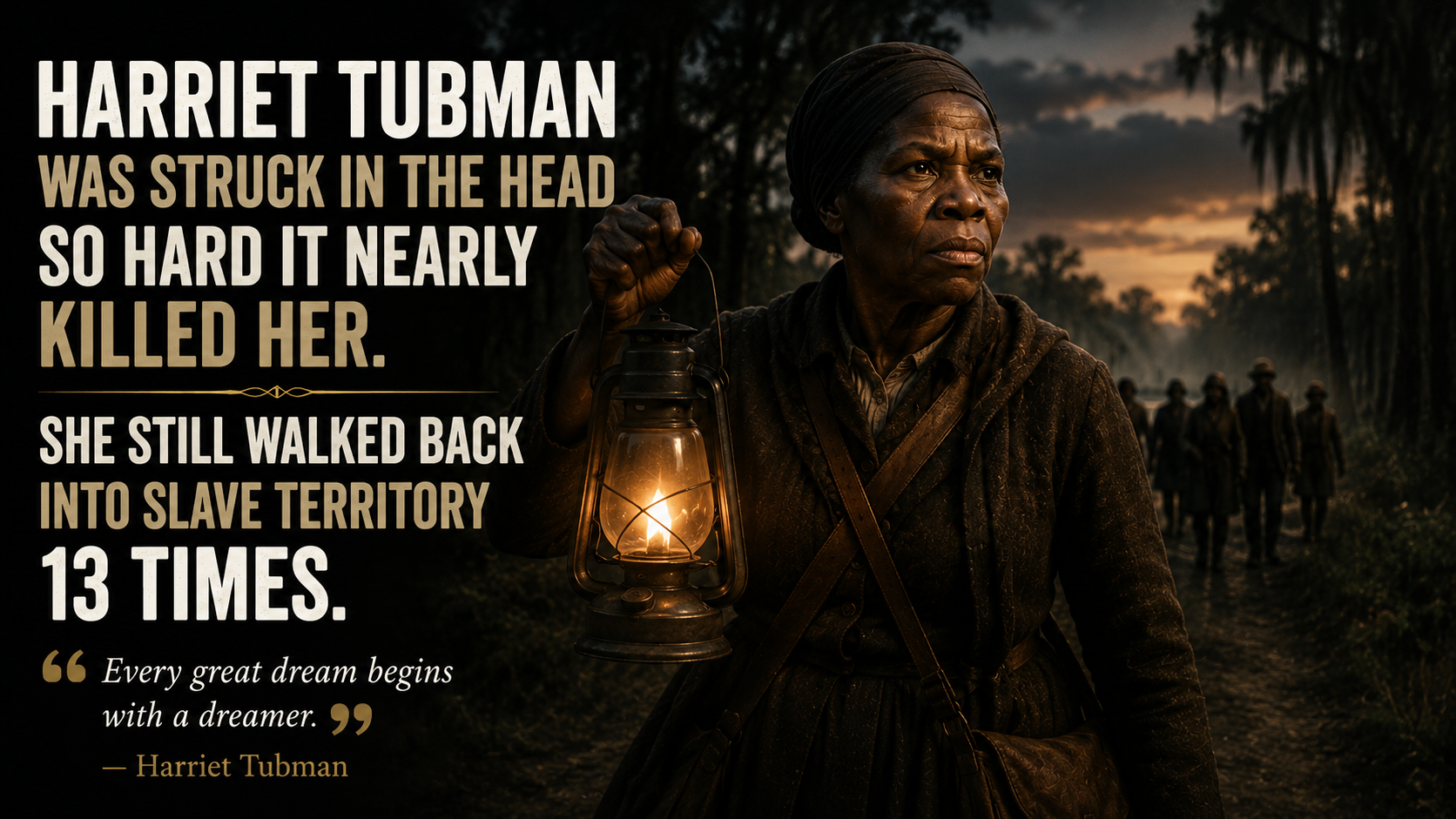
In brief: As a teenager, Harriet Tubman was hit in the head with a heavy iron weight, an injury so severe she carried seizures, blackouts, and blinding headaches for the rest of her life. No doctor ever treated her for it. She never let it stop her. Over the next decade, she walked back into the exact place she’d escaped from, again and again, to bring others out with her.
Can I ask you something before we start?
If your body could just… shut off. No warning. No pattern. Any moment, any place — you’d lose consciousness for minutes at a time, and there’d be nothing you could do to stop it.
Would you still leave the house?
I’m serious. Really sit with that for a second, because most people don’t. Most of us would build our whole lives around staying safe. Staying somewhere familiar. Staying close to people who could help us if something went wrong.
Harriet Tubman didn’t have that condition by choice. It was put on her, violently, when she was still a kid. And what she did with it afterward is honestly one of the things I think about most, on the nights I’m talking to people who feel like their body or their mind has become something unpredictable, something they can’t fully trust anymore.
So let me tell you what actually happened to her. Not the version with the big round numbers everyone’s heard. The real one.
The Moment Everything Changed
She was around 12. A young teenager, enslaved, standing in a store on an ordinary errand. Nearby, an enslaved man tried to run. The overseer grabbed something heavy — an iron weight — and threw it at him to stop him.
It missed him.
It hit her instead. Right in the head.
Take a second with that image. A child, standing where she’s not supposed to be in anyone’s way, catching a blow that was never meant for her, hard enough to drive part of her skull inward. (National Museum of African American History and Culture)
Nobody took her to a doctor. She was enslaved — that kind of care simply wasn’t something anyone thought she deserved. She was sent home, and for a while, her family genuinely didn’t know if she’d wake up again.
She did wake up. But something in her had changed for good.
What Nobody Talks About
For the rest of her life — and I mean every single year that followed, decades of it — Tubman would suddenly lose consciousness. No warning. Sometimes for a few minutes. Sometimes longer. Crushing headaches came with it. One eyelid drooped permanently and never fully corrected. (MyNarcolepsyTeam)
Historians today think it was some combination of seizures and narcolepsy. But honestly? Nobody can say for certain, because nobody with any medical training ever actually looked at her for it. That’s the part that gets me every time I sit with this story. She lived with a severe, disabling condition for fifty-plus years, and not one single doctor ever examined her for it. Not once.
I want you to just imagine that for a moment. Imagine carrying something that big, that scary, completely alone — no name for it, no explanation, nobody to tell you it’s real and not your fault.
Does any part of that feel familiar to you? Maybe not the specifics. But that feeling — something’s wrong, and nobody’s really looking at it, and you just have to keep functioning anyway?
I’d guess a lot of you know that feeling better than you’d like to.
She Didn’t Get Smaller. She Got Stronger.
Here’s what gets me, though. Tubman didn’t respond to this by shrinking. By multiple accounts, she became known — even while enslaved, even with this condition — for carrying loads of wood that grown men struggled to lift. She was under five feet tall. (National Museum of African American History and Culture)
She took what the injury left her with, and instead of protecting it carefully, she pushed it. Hard.
I don’t think that’s an accident. I think when something’s already taken so much from you, sometimes the only way through is to prove — mostly to yourself — that it hasn’t taken everything.
She Got Free. Then She Went Back.
In 1849, her enslaver died, and Tubman and her family faced the real threat of being sold off, split apart forever. So she left. On foot. Ninety miles, Maryland to Philadelphia, moving through a hidden network of safe houses that history now calls the Underground Railroad.
She made it. She was free.
Now — if that were you, what would you do next? I think most of us would just breathe. Stay put. Be quietly, deeply grateful we made it out at all.
Tubman turned around and walked back in.
On purpose. Into the exact place she’d just escaped.
Thirteen Times
Over the next ten years, she went back roughly 13 times. Each trip, she was walking straight back into danger to lead others out — mostly people she already knew and loved, family, friends, people she trusted with her life because she was quite literally trusting them with it. By her own count, she brought around 70 people to freedom this way, and she said, proudly, she never lost a single one. (National Park Service)
You might have heard bigger numbers — 300 people, 19 trips. That version comes from a biography written after she’d already passed, and it stretched things further than she ever claimed herself. I actually don’t think the real number needs any stretching. Sit with 13 for a second. Thirteen separate times, she chose the walk back into danger. That’s not a legend. That’s a woman making the same hard decision, over and over, on purpose. (National Park Service)
Think about what one of those trips actually involved. Days of walking, at night, through territory where getting caught meant death or worse. Leading frightened people who were counting on her to get every single decision right. She carried a small pistol — partly for slave catchers, but also, it’s said, to keep her own group moving if someone’s fear got the better of them halfway through. (National Park Service)
And the entire time — every mile, every trip — her body could shut off without a second’s warning.
I keep asking myself: how do you even prepare for that? You can’t. You just have to decide the people on the other side of that risk matter more than the fear of the risk itself. And then you have to actually do it. Not once. Thirteen times.
What would you have done, in her place? I want you to actually answer that, even just to yourself. Most of us would’ve had every reasonable excuse to stay. Nobody would have blamed her for staying. She chose the harder thing anyway, again and again, for people whose names she knew.
What She Believed About Her Own Blackouts
Here’s a detail I love. Tubman believed her episodes were connected to something spiritual — vivid dreams and visions during her blackouts, which she read as guidance, sometimes even warnings, about the road ahead. (Grunge)
You don’t have to believe what she believed to notice what she was doing with it. She wasn’t hiding her condition, treating it like a shameful secret to manage quietly. She folded it into her understanding of her own strength. It became part of how she trusted herself, not a reason to trust herself less.
What if you did that with whatever unpredictable thing you’re carrying? Not pretending it isn’t hard. Just… refusing to let it be the whole story about who you are.
She Didn’t Stop There, Either
The Underground Railroad wasn’t the end of her. During the Civil War, she worked for the Union Army as a scout, a spy, a nurse. In 1863, she helped plan and lead a raid along the Combahee River that freed more than 700 people in a single night — the first time in American history a woman had led a military operation like that. (National Women’s History Museum)
Later, she fought for women’s right to vote. She opened a home in New York for elderly Black Americans who had nowhere else to go. She kept working, in one form or another, for the rest of her life — carrying that same untreated injury the entire time, decades after the blow that started it all. (National Women’s History Museum)
Okay. Here’s What I Actually Want You to Take From This.
Tubman never got a diagnosis. Never got treatment. Never got a single guarantee that the next blackout wouldn’t hit at the worst possible second, with someone else’s life in her hands.
She went back anyway. Thirteen times. For people she loved.
So let me ask you the real question. Not a rhetorical one — an actual one, that I want you to sit with for longer than five seconds.
What are you telling yourself you can’t do, because of something you’re carrying? A diagnosis. A limitation. Something about your body or your mind that feels unfair, unpredictable, too big to plan around.
Tubman had every reasonable excuse to stay somewhere safe. She chose the harder road instead, again and again, because the people on the other side of it mattered more to her than the fear did.
You don’t have to walk ninety miles or lead a raid to take something from that. You just have to ask yourself, honestly: what would I do differently if I stopped waiting for the fear to go away first?
I don’t think it ever fully goes away. I think you just decide it doesn’t get the final word. Never give up.
Frequently Asked Questions
How many people did Harriet Tubman rescue?
By her own count and the best historical documentation, around 70 people across roughly 13 trips back into Maryland. (National Park Service)
What injury did Harriet Tubman have?
As a teenager, an overseer’s thrown weight struck her in the head, causing a traumatic brain injury that led to lifelong seizures or narcolepsy-like blackouts, severe headaches, and vivid visions. She never received medical treatment for it. (National Museum of African American History and Culture)
Did Harriet Tubman really never lose a passenger?
That’s what she herself claimed, and it’s consistent with the historical record of her documented trips. (National Park Service)
What did Harriet Tubman do after the Underground Railroad?
She served the Union Army during the Civil War as a scout, spy, and nurse, led the Combahee River raid that freed over 700 people, and later advocated for women’s suffrage and opened a home for elderly Black Americans. (National Women’s History Museum)
If you’re carrying something unpredictable that’s holding you back, talk to Risha — your AI friend, here any time you need someone to talk it through with.
Get a story like this every week: Join the Project Never Give Up newsletter — it’s free.