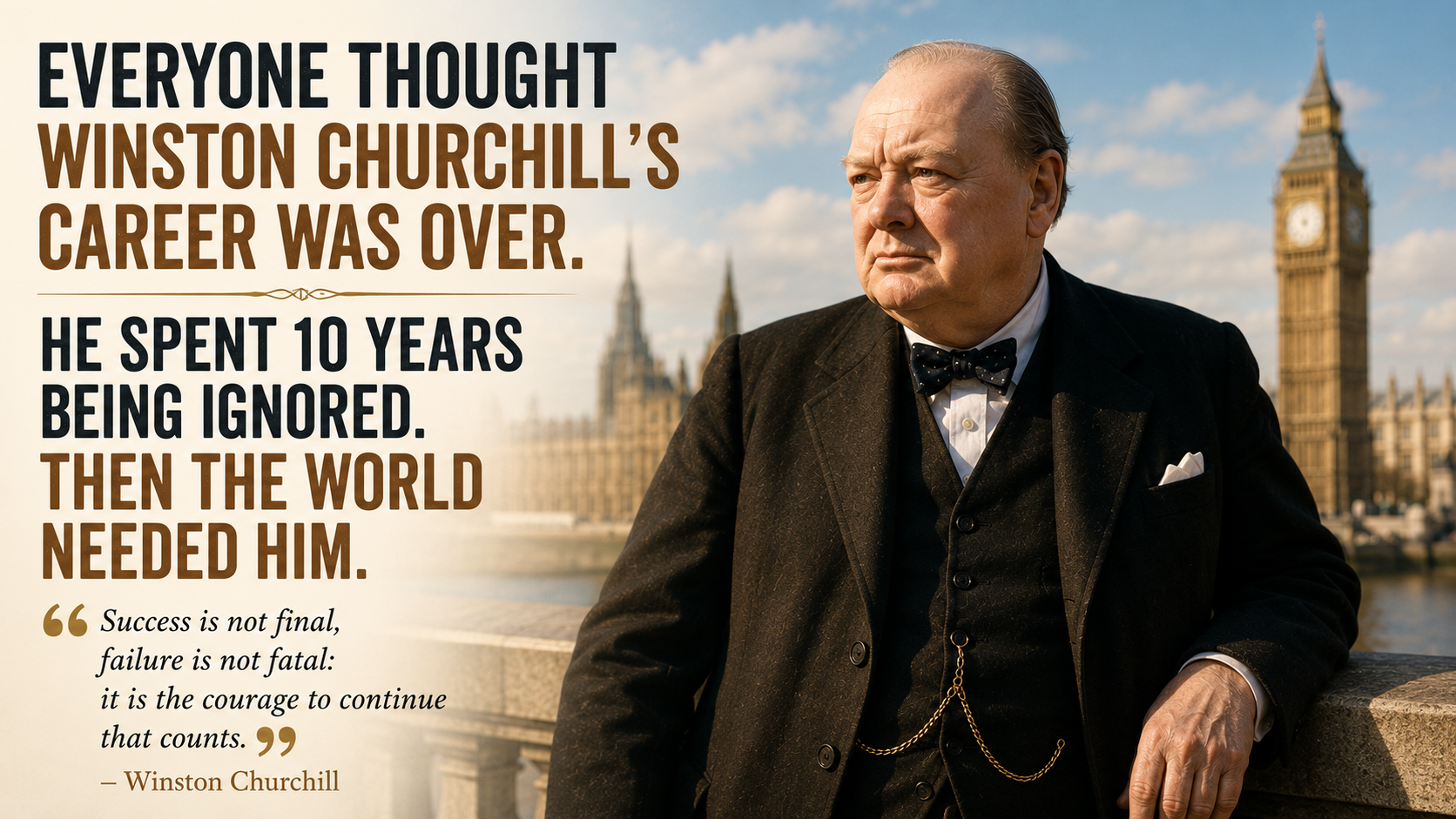
In brief: For ten straight years, Winston Churchill held no government position and was treated as a political has-been by his own party. He spent that decade writing, painting, and warning anyone who’d listen about a threat almost nobody wanted to hear about: Nazi Germany. When war broke out in 1939, he was called back within hours. Eight months later, at 65, he became Prime Minister.
Ten years.
Not ten bad months. Not one rough year you can tell yourself you’ll bounce back from. Ten straight years where the people in charge look at you and decide, over and over, that you’re just not worth including anymore.
Could you keep showing up for that? Honestly — I want you to actually think about it before you answer. Ten years of being politely, and sometimes not so politely, told you’re finished.
That’s not a hypothetical. That’s exactly what happened to Winston Churchill. And it’s the part of his story almost nobody tells you, because everyone jumps straight to the speeches and the war and the man standing at the podium in 1940. Nobody wants to sit in the ten years before that. But that’s where the real story is. So let’s sit in it for a minute.
1929: The Door Just… Closes
Churchill was 54. Already one of the most experienced politicians in Britain — he’d held some of the biggest jobs in government there were. Then his party lost an election, and something shifted that had nothing to do with voters rejecting him personally.
He kept his seat in Parliament. He just stopped getting invited to matter.
For the next ten years, nobody in his own party would give him a job. Not because he lost an election for one. Because the people running things had quietly decided he wasn’t worth the trouble. (Wikipedia)
He called this stretch his “Wilderness Years.” I think about that name a lot. A wilderness isn’t just being lost. It’s being lost somewhere nobody’s coming to look for you.
I Have to Be Honest With You About Something
Churchill wasn’t some quiet, misunderstood genius sitting patiently on the sidelines, waiting to be proven right. He picked fights. Real ones. He took positions — against independence for India, in support of a king who was about to lose his crown — that put him at odds with basically everyone, on both sides of the aisle. By the mid-1930s, plenty of people in Parliament found him genuinely exhausting to be around. (History Hit)
I’m telling you that because I don’t want this to feel like a simple story where the good guy gets ignored and then wins. It’s messier than that. He was wrong about plenty. But there was one thing — one single thing — he kept saying, year after year, that turned out to matter more than everything else he ever said combined.
The Warning Nobody Wanted
Starting in the early 1930s, Churchill began warning that Germany was rearming, fast, and that Britain wasn’t ready for what was coming. He had no government job. Which meant, officially, he had no right to any of the intelligence that would back up what he was saying. So he built his own network — people inside the intelligence services who quietly passed him real numbers on German weapons and troops, sometimes with the knowledge of the very Prime Ministers whose policies he was using that intelligence to publicly attack. (Wikipedia)
Picture that for a second. A man with no power, standing up in Parliament again and again, reading out numbers almost nobody wants to hear, about a danger almost nobody believes in yet. Britain’s whole mood at the time was set on appeasement — give Hitler what he wants, and the peace holds. Churchill’s warnings went directly against that. And for years, he just… lost. Publicly. Over and over. (History Hit)
Here’s what I keep wondering when I read about this part. What does it actually take to keep saying the same true thing, year after year, and watch it get waved off every single time — with absolutely no guarantee you’ll ever be proven right? No guarantee you won’t just spend the rest of your career as the guy everyone rolls their eyes at?
Have you ever had to do that? Keep saying something true that nobody around you wants to hear? I’m guessing at least a few of you reading this know exactly what that feels like.
What He Was Actually Doing With All That Time
He wasn’t sulking. That’s the thing people get wrong. From his home in Kent, he was writing constantly — history books, a bestselling memoir, newspaper columns that paid his bills through a decade where he’d also lost real money in the 1929 stock market crash. He picked up oil painting in these years too, and it stayed with him the rest of his life. (Wikipedia)
He had no idea any of it would matter. None. He just kept working, kept warning, kept writing — with zero proof it was building toward anything at all.
I want you to sit with that for a second, because I think it’s the actual heart of this story. Not “he knew he’d be right eventually.” He didn’t know. He just kept going anyway.
The Moment the World Caught Up
September 1938. Britain’s government signs the Munich Agreement, handing part of Czechoslovakia to Hitler in exchange for a promise of peace. The country celebrates. Churchill stands up and calls it a disaster.
Almost nobody agrees with him. (International Churchill Society)
Six months later, Hitler breaks that promise and takes the rest of Czechoslovakia anyway.
And just like that — not because Churchill argued better, not because he finally found the right words — reality simply caught up to what he’d been saying the whole time. (International Churchill Society)
When Britain declared war in September 1939, the Prime Minister — the same man whose appeasement policy Churchill had spent a decade fighting — didn’t really have a choice anymore. He brought Churchill back into government that same day. Eight months later, as the war turned into a genuine catastrophe, that Prime Minister resigned. Churchill took his place.
He was 65. (International Churchill Society)
Here’s What I Actually Want You to See
None of what made Churchill capable of leading Britain through its worst hour would exist if his party had just kept him comfortable through the 1930s. Given him some minor post, kept him busy, kept him quiet.
The wilderness years forced him to learn Germany’s military threat piece by piece, from unofficial sources, because nobody would give him official ones. They forced him to sharpen his writing across millions of published words — the exact skill that, within a year of becoming Prime Minister, would produce speeches people still quote today. And they gave him something a comfortable career never could have: a reputation, earned the hard way, as the one senior figure in Britain who hadn’t been wrong about the thing that mattered most.
So let me ask you this, and I actually want you to answer it, not just skim past it. If you’re doing work right now that nobody seems to value — saying something true that nobody wants to hear, watching your effort seemingly go nowhere for way longer than feels fair — what would it look like to keep going anyway? With no promise. No guarantee the world ever comes around.
Could you do that for a year? Because Churchill did it for ten.
What This Actually Means for You
It’s tempting to tell this story as “he was right, and eventually everyone realized it.” That’s true. But it skips the part that actually matters to you, reading this right now. For ten years, Churchill built a case nobody wanted, doing work that didn’t look like it was going anywhere, with no proof it would ever be needed. He didn’t know, in 1935, that any of it would matter.
He kept doing it because he believed it was true.
That’s what most real comebacks actually look like, by the way. Not one dramatic moment where everyone finally sees you clearly. A long, unglamorous stretch of work, continued without any proof it’ll pay off. So — what’s the true thing you’re still saying, even though nobody’s listening yet? Keep saying it. Never give up.
Frequently Asked Questions
What were Winston Churchill’s “Wilderness Years”?
The decade from 1929 to 1939, when Churchill held no government position after his party fell out of power and largely turned against him over his stances on India and the Abdication Crisis. (Wikipedia)
Why didn’t people believe Churchill’s warnings about Hitler?
His other unpopular positions had already damaged his credibility, and his warnings went directly against Britain’s dominant strategy of the time, appeasement, which favored negotiation over confrontation with Germany. (History Hit)
How did Churchill return to power?
When Britain declared war in September 1939, he was immediately brought back into government. He became Prime Minister eight months later, in May 1940. (International Churchill Society)
Was Churchill right about everything in the 1930s?
No — his positions on India and the Abdication Crisis were controversial and are viewed critically by many historians today. His warnings about German rearmament, however, proved accurate. (History Hit)
If you’re saying something true right now and nobody’s listening yet, talk to Risha — your AI friend, here any time you need someone to talk it through with.
Get a story like this every week: Join the Project Never Give Up newsletter — it’s free.