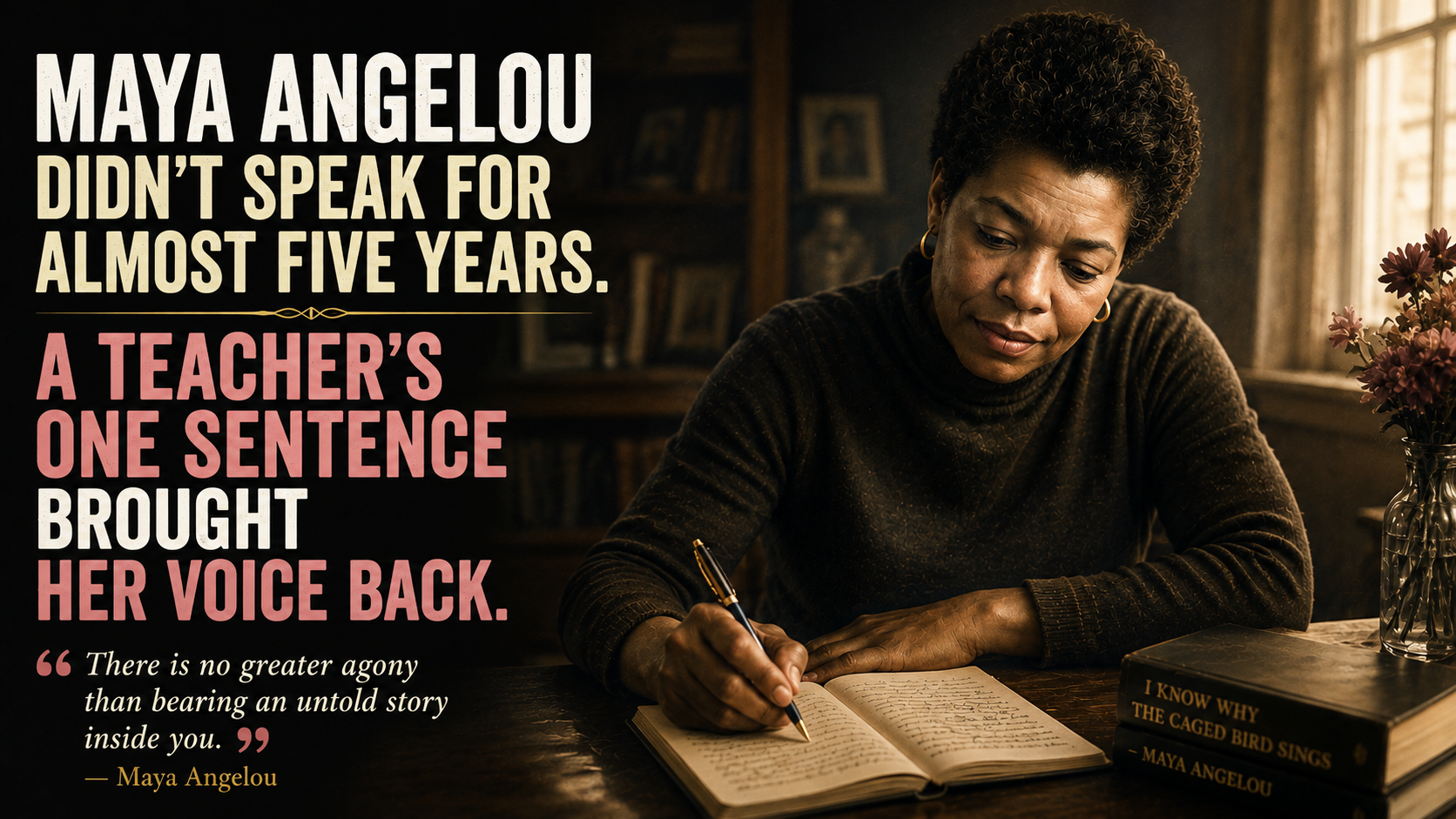
In brief: As a child, Maya Angelou survived a sexual assault and, believing her own words had led to her attacker’s death, stopped speaking almost entirely for nearly five years. During her silence, she read everything she could find and memorized poetry. A teacher eventually reached her — not by pushing her to talk, but by connecting her back to the thing she’d never stopped loving. Angelou went on to become one of the most widely read writers in America.
Note: This article discusses childhood sexual abuse, referenced factually and without graphic detail, as recorded in Angelou’s own memoir. Please take care while reading, and see the resources at the end of this article if you need them.
What if the thing you loved most became the thing you were most afraid of?
I want you to actually picture that. Not just words on a page — the thing that words are to you, the way you use language to be understood, to connect, to just exist in the world around other people. Now imagine believing that exact thing is dangerous. That if you use it, someone could die.
That’s not a metaphor for what happened to Maya Angelou. That’s literally what she believed. And she was seven years old.
What Happened to Her
She was raped by her mother’s boyfriend. She told her family, because that’s what she’d been taught to do — tell someone, trust the adults, let them handle it. He was arrested, convicted… and then released after barely a day. A few days later, he was found dead. (PushBlack)
She was a child. A child trying to make sense of something no child should ever have to make sense of. And in that confusion, she landed on a conclusion that broke my heart the first time I read it in her own words: that her voice had caused his death. That speaking was what killed him.
So she stopped. Not for a few weeks while she processed it. Not for a school term.
Almost five years. (The New World)
Try to Actually Sit In That For a Second
Five years. Every single day, moving through her house, her school, her whole town — without speaking. Not because she physically couldn’t. Because some part of her, the part still trying to survive something unspeakable, was convinced that if she opened her mouth, it would happen again.
She was sent to live with her grandmother in Stamps, Arkansas. She described that first year like this: “like an old biscuit, dirty and inedible.” Read that phrase again. That’s a child describing herself. (Pedagogy for Change)
What she was living with is something doctors today would likely call selective mutism. And I want to be really clear about this part, because it matters: it’s not stubbornness. It’s not a choice a kid makes on a whim. It’s fear, doing exactly what fear does when it completely takes over. Nobody chooses that. It happens to you. (Goalcast)
Have you ever gone quiet after something hard happened to you? Maybe not five years. Maybe just a week, or a conversation you kept avoiding, or a truth you couldn’t say out loud yet. If you have, even a little — you already understand something true about what she went through.
She Wasn’t Empty. She Was Filling Up.
Here’s the part of this story I think about the most. Angelou wasn’t shut down during those years. She was absorbing everything.
She read constantly — Shakespeare, Dickens, Poe, and Black poets like Georgia Douglas Johnson, whose words reached something in her own life that nothing else could touch. She read every book her local library had. And she memorized long passages — plays, poems, not for school, just because holding language inside her was the only way she knew how to keep it close while she couldn’t let it out. (The New World)
If you couldn’t speak for five years, what would you do with all that silence? Be honest with yourself for a second. I think most of us would just wait it out, hoping it eventually passes on its own.
Angelou built something inside it instead. An ear for rhythm. A memory sharpened by years of pure, undivided listening. A private relationship with language most writers spend their whole careers trying to find.
She wrote something, years later, that only makes sense once you understand what those years actually held: “There is no greater agony than bearing an untold story inside you.” (The New World)
The Sentence That Changed Everything
When Angelou was around 13, a family friend named Mrs. Bertha Flowers started paying real attention to her. Not pity. Genuine interest. She lent her books. She talked with her, and let Angelou answer however she could — in writing, with a nod, whatever worked. She never pushed. (Pedagogy for Change)
And then, one day, she asked Angelou to read a poem out loud.
Angelou hesitated. Of course she did — five years of believing her voice was dangerous doesn’t just evaporate because someone hands you a poem.
So Mrs. Flowers said something instead. One sentence. The kind of sentence that changes the whole direction of a life:
“You do not love poetry, not until you speak it.”
Sit with how smart that actually is. She didn’t say “just talk again.” She didn’t demand anything. She pointed at the one thing Angelou had never stopped loving, even in the silence, and said: this only fully belongs to you once you give it a voice. (The New World)
Angelou started reading. Haltingly, at first. And then, by her own account, she couldn’t stop. Five years of held-in language, pouring back out. (When In Your State)
Can you imagine that moment? Five years of silence, and then suddenly, your own voice, in your own mouth, and it doesn’t kill anyone. It just… exists. It’s yours again.
What Came After
Her life didn’t smooth out overnight just because she was speaking again. At 16, she became the first Black female cable car conductor in San Francisco. At 17, she had her son, Guy, and worked a string of jobs to support them both. She performed in a touring production of Porgy and Bess, sang calypso in nightclubs, and eventually found her way to the Harlem Writers Guild, where she met James Baldwin and other writers who pushed her toward the work she’d become known for. (Wikipedia)
In 1969, she published I Know Why the Caged Bird Sings — the memoir where she tells this exact story, in her own words, for the first time. It became one of the most important American memoirs ever written. Still widely read, more than fifty years later. In 1993, she became only the second poet in U.S. history to read at a presidential inauguration. In 2010, President Obama gave her the Presidential Medal of Freedom, and told the crowd his own sister was named after her. (The New World)
Here’s What I Actually Want You to Take From This
I don’t want to tell you those five years were secretly a gift. What happened to her was real, and awful, and nobody should have to live through it. But it’s also true — and I think this matters — that those years shaped the writer she became. Her prose carries the unmistakable rhythm of someone who spent years listening before she ever spoke. Careful. Unhurried. Like every sentence had already been tested silently, many times, before she let it go.
The lesson here isn’t “silence is secretly good for you.” It’s gentler than that, and I think more useful: the years when you can’t yet do the thing you’ll eventually be known for aren’t necessarily wasted, even when they don’t feel like progress. Angelou wasn’t writing during her silence. But she was reading. Listening. Holding onto language. Quietly building, without even knowing it, exactly what her voice would need once it finally came back.
So — where are you right now? Maybe you’re in a season where you don’t have the words yet. Something happened, and you can’t talk about it, or you won’t, or you genuinely don’t know how yet.
What would it look like to let that be okay, just for now? Not to force it. Just to keep reading, keep listening, keep noticing — and trust that you’ll know when you’re ready to speak.
You don’t have to find your voice before you’re ready. But when you are, know this: whatever you’ve been holding onto has value. Let it out, in your own time, to someone who asks for it the right way. Never give up.
Frequently Asked Questions
Why did Maya Angelou stop speaking as a child?
After surviving a sexual assault at age seven and believing her testimony had caused her attacker’s death, Angelou developed selective mutism, a trauma response, and did not speak in any sustained way for close to five years. (Goalcast)
How did she start speaking again?
A teacher and family friend, Mrs. Bertha Flowers, built trust with her through books, then asked her to read a poem aloud, telling her “you do not love poetry, not until you speak it.” Angelou began reading and found she couldn’t stop. (The New World)
What did she do during her years of silence?
She read constantly and memorized long passages of poetry and plays, developing an unusually strong memory and a deep sensitivity to language. (When In Your State)
What is Maya Angelou best known for?
Her 1969 memoir I Know Why the Caged Bird Sings, her poetry, and decades of work as a writer and civil rights activist. (The New World)
If you’re carrying something you haven’t found the words for yet, talk to Risha — your AI friend, here any time, no pressure to speak before you’re ready.
If this article has raised difficult feelings related to sexual abuse, support is available. In the US: RAINN National Sexual Assault Hotline — 1-800-656-4673. In the UK: Rape Crisis England & Wales — 0808 802 9999.
Get a story like this every week: Join the Project Never Give Up newsletter — it’s free.