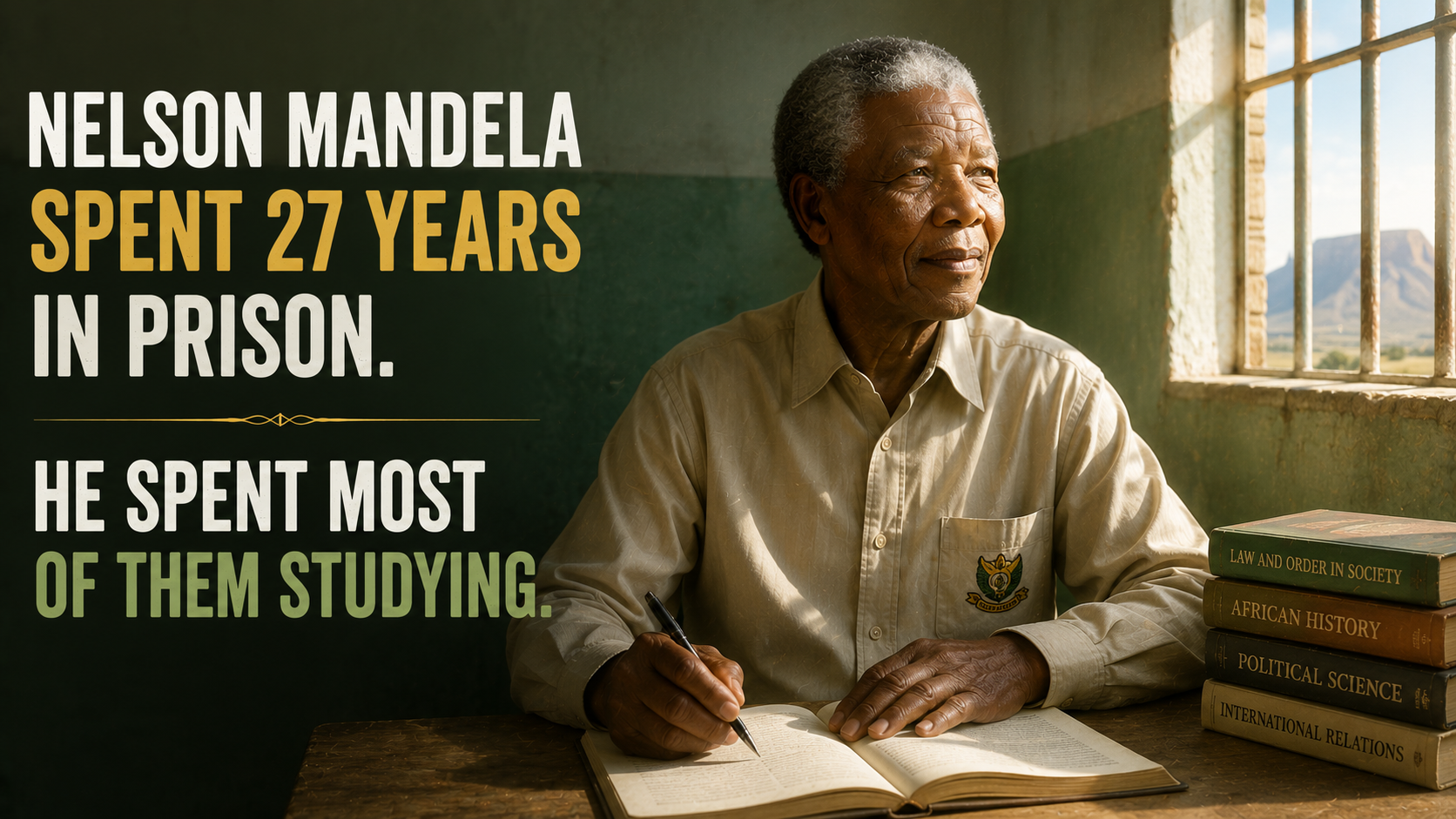
In brief: Nelson Mandela was 44 when he was sentenced to life in prison. He was 71 when he walked out. In between, he studied law by post, taught other prisoners, and even educated some of his own guards. He didn’t wait for release to start becoming who he needed to be. He built it inside the sentence.
Do the math with me for a second.
Twenty-seven years. That’s nearly the whole span most people spend building a career, raising kids, becoming who they’re going to be. Nelson Mandela spent it in a cell roughly the size of a small bathroom, on an island prison, mostly with no idea if he’d ever get out. (Britannica)
What would you do with twenty-seven years you didn’t choose and couldn’t end?
I think most of us would just try to survive it. Mandela didn’t just survive it. And the part of his story that actually gets me isn’t the ending — the presidency, the Nobel Prize, all of that. It’s what he did with the years nobody was watching.
Eighteen Years in a Quarry
From 1964 to 1982, Mandela was held at Robben Island, off the coast of Cape Town — a brutal place. Most prisoners had no beds, no plumbing. Days were spent on hard labor, much of it in the island’s limestone quarry. Family visits were rare. Any small infraction could mean solitary confinement. (Shortform)
This is the environment Mandela decided to finish his education in.
The University Nobody Built On Purpose
For most of his twenty-seven years, Mandela studied law by post through the University of London. Try to picture how that actually worked. He’d request a book on contract law. The request would get processed, mailed. And between the unreliable post, the island’s remoteness, and censors who — in his own words — were often deliberately slow, the book would frequently arrive after it was already due back. Plenty of the books he asked for were simply banned before they ever reached him. (University of London)
He passed his first set of exams in 1963. It took him, by some accounts, more than forty years and multiple long interruptions to actually finish the degree. (Shortform)
Now here’s the part I really want you to notice. He didn’t study just for himself. He encouraged other prisoners to enroll in their own courses. He organized informal seminars where inmates taught each other — law, history, whatever anyone actually knew. One former prisoner, Lionel Davis, who was there from 1964 to 1971, later called it “the University of Robben Island.” “I was not the same person when I left the island,” Davis said. “I learned so much. It was a university created by us, the political prisoners.” (AP via Fox News)
Can you imagine building a university inside a prison? Not because anyone asked you to. Because you decided the years still counted, even there.
He Even Taught the People Guarding Him
Here’s the detail that tells me this wasn’t just discipline — it was strategy. Plenty of the guards at Robben Island were young, with far less formal education than the political prisoners they were watching over. Mandela didn’t treat that as an indignity. He treated it as leverage — a way to build something closer to an equal relationship, across a line specifically designed to keep him powerless. To guards he thought might actually listen, he explained what the ANC was actually fighting for. “Education was the enemy of prejudice,” he believed. (Robben Island leadership accounts)
Think about that. He was in a cell because of the very system those guards enforced. And instead of only resenting them — which would’ve been completely fair — he also saw them as people he might be able to reach.
What Twenty-Seven Years Actually Built
He was moved to Pollsmoor Prison in 1982, then Victor Verster Prison in 1988 after treatment for tuberculosis, before his release in February 1990. (Britannica)
It would already be a remarkable story if Mandela had simply endured all those years without breaking. What makes it a different kind of story is that he used them. He didn’t wait for release to begin becoming the leader his country needed. He built that person inside the sentence — page by smuggled page, seminar by seminar, one educated guard at a time.
When he walked out in 1990, he wasn’t just free. He was ready, in a way that almost three decades of deliberate, unglamorous study had made possible. Four years later, he was president. In 1993, he and South African president F.W. de Klerk — his former adversary — jointly won the Nobel Peace Prize. (Opening the Sky)
What I Actually Want You to Take From This
Mandela wrote something once that I think about a lot: “Prison is itself a tremendous education in the need for patience and perseverance. It is, above all, a test of one’s commitment.”
He didn’t just pass the test of enduring it. He used the time the test demanded of him.
So let me ask you something real. Are you in a season right now that feels like it’s on hold? A wait you didn’t choose, a delay, a stretch of time that feels wasted because it’s not moving toward anything visible yet?
What would it look like to treat that time the way Mandela treated his — not as dead time to simply get through, but as raw material for who you’re going to be on the other side of it? You don’t need a cell or a sentence to ask that question. You just need to actually ask it. Never give up.
Frequently Asked Questions
How long was Nelson Mandela in prison?
27 years in total, across several facilities, from his 1962 arrest and 1964 life sentence until his release in February 1990. Eighteen of those years were on Robben Island. (Britannica)
What did Mandela study in prison?
He pursued a law degree through the University of London as a distance-learning student for much of his imprisonment, despite severe restrictions on which books and materials he could access. (University of London)
What was the “University of Robben Island”?
An informal name former political prisoners gave to the culture of education Mandela and others built on the island — correspondence courses, group seminars, and prisoners teaching each other and, at times, their guards. (AP via Fox News)
What did Mandela do after his release?
He led negotiations to end apartheid, was elected South Africa’s first Black president in 1994, and shared the 1993 Nobel Peace Prize with F.W. de Klerk. (Opening the Sky)
If you’re in a season that feels like it’s on hold, talk to Risha — your AI friend, here any time you need help thinking about how to use it.
Get a story like this every week: Join the Project Never Give Up newsletter — it’s free.