Have you ever been told you’re not good enough at the one thing you love most?
Not by a stranger. Not by an anonymous comment on the internet. But by someone in authority — someone whose verdict felt final, official, and devastating.
That’s what happened to Walt Disney in 1919. He was eighteen years old, working at the Kansas City Star newspaper, drawing for a living. His editor called him in, looked him in the eye, and told him he was being let go.
The reason? He “lacked imagination and had no good ideas.”
The man who would go on to create Mickey Mouse, Snow White, Cinderella, Disneyland, and a $130 billion entertainment empire — the man who would win more Academy Awards than any individual in history — was told at the start of his career that he had no imagination.
He didn’t argue. He didn’t beg. He walked out of the building and started drawing again.
What happened next is not a clean story of triumph. It is a long, brutal, expensive, lonely journey through failure after failure — with one man’s conviction burning at the centre of all of it, refusing to go out.
This is that story.
The Boy Who Drew Everything
Walter Elias Disney was born on December 5, 1901, in Chicago, Illinois. He grew up mostly in Marceline, Missouri — a quiet farming town where he spent his childhood drawing animals, landscapes, and anything that held still long enough. He drew on whatever he could find. He sold sketches to neighbours. He drew for his high school newspaper. Art wasn’t something Walt did. It was something Walt was. (Britannica)
At sixteen, he tried to enlist in the army during World War I. Too young by a year, he altered his birth certificate and joined the Red Cross as an ambulance driver in France instead. He came home at eighteen with a head full of images and nowhere particular to put them — so he went looking for a job as a commercial artist. (Wikipedia)
The Kansas City Star hired him. Then fired him. No imagination. No good ideas.
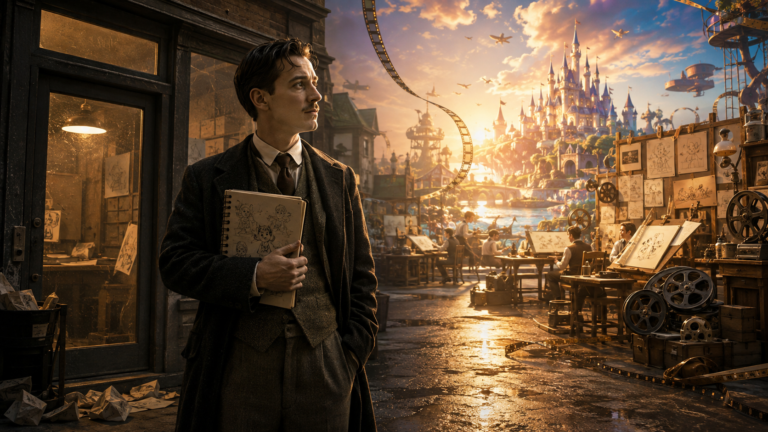
Most people, handed that verdict at eighteen by a man with the authority to make it stick, would absorb it. Would quietly wonder if it was true. Walt Disney went and found a camera.
The Studio That Fell Apart — And the Mouse That Was Born In It
Disney threw himself into animation. He and his friend Ub Iwerks began producing hand-drawn cartoon shorts and struck a deal with a local Kansas City theatre to screen them. The cartoons were good enough that Walt was able to open his own studio — Laugh-O-Gram Films — hire a team of young animators, and start building something real. (Wikipedia)
He was twenty years old. It felt like the beginning of everything. Then the distributor who owed them $11,000 went bankrupt. The money never came. Disney tried everything — cutting staff, cutting salaries, skipping meals. One by one, the people around him left. (SlashFilm)
By the summer of 1923, Walt Disney was completely alone in the Laugh-O-Gram office. No money. No staff. He couldn’t afford rent, so he slept on the studio couch. He bathed once a week at the local Union Station — ten cents a visit — because it was the cheapest option available to him. (Wikipedia)
Late at night, alone in the office, he wasn’t entirely alone. There were mice living in the wastepaper baskets. Walt caught one and put it in a wire cage on his desk. He sketched it. Some believe that mouse was the original inspiration for Mickey Mouse. Walt never confirmed it. But he never denied it either. (Joshua Kennon)
In July 1923, Laugh-O-Gram filed for bankruptcy. Walt left Kansas City with $40 and a cardboard suitcase. He was twenty-one. Bankrupt. Alone. Starting again. And yet he later said of that period: “I was happy all the time. I was excited. I was doing things.” The outside world saw ruin. Walt Disney saw a workshop. (SlashFilm)
Hollywood, Oswald, and the Day He Lost Everything Again
In Los Angeles, his brother Roy was recovering from tuberculosis. Together they started again — the Disney Brothers’ Cartoon Studio, out of their uncle’s garage. After months of rejection, Disney found success with the Alice Comedies, then with Oswald the Lucky Rabbit. (Wikipedia)
He travelled to New York in 1928 to negotiate a better deal — and discovered his distributor, Charles Mintz, had quietly poached his best animators and owned the rights to Oswald entirely. Accept a pay cut and work under Mintz, or walk away with nothing. (Wikipedia)
Disney walked away. His character was gone. His animators were gone. He was twenty-six and starting from nothing for the third time. He picked up a pencil and started drawing on the train.
The Mouse That Changed Everything
On that train ride — broke, betrayed — Walt Disney sketched a cheerful mouse with round ears, red shorts, and yellow shoes. He named him Mortimer. His wife Lillian suggested Mickey instead. (Britannica)
On November 18, 1928, Steamboat Willie premiered — the first cartoon with fully synchronised sound. Mickey Mouse was an overnight sensation, and this time, Disney owned him completely. He never sold his creative rights again. (Wikipedia)
“Disney’s Folly” — The Film Nobody Believed In
In 1934, Disney announced his vision for a feature-length animated film based on Snow White. The Hollywood press nicknamed it “Disney’s Folly.” His brother Roy thought it was too risky. Bankers refused to lend him the money. (Biography.com)
Disney made it anyway. Snow White and the Seven Dwarfs premiered on December 21, 1937. The audience gave a standing ovation. It became the highest-grossing film of 1938. Disney’s Folly saved the studio and reshaped cinema forever. (Wikipedia)
The Park That “Would Never Work”
In the early 1950s, Disney had the idea for a clean, imaginative theme park where parents and children could share wonder together. Everyone he told thought he was losing his mind — his wife, his brother, the bankers who rejected his loan applications over and over. (Wikipedia)
Disney mortgaged his life insurance policy and kept going. Disneyland opened on July 17, 1955. Opening day was a genuine disaster — overcrowding, broken rides, food shortages. The press called it “Black Sunday.” Within seven weeks, one million people had visited. Today, Disney Parks generate over $9 billion in annual revenue. (History.com)
What He Left Behind
Walt Disney died on December 15, 1966, at 65 — before Disney World opened. He and his studio won 48 Academy Awards — more than any individual in history. The Walt Disney Company today is worth over $130 billion. It was all built by a man his first editor dismissed as having no imagination. (D23)
What His Story Actually Teaches
Fired at 18. Bankrupt at 21. Betrayed at 26. Mocked at 33. Rejected by banks and his own brother at 50. At every stage, someone with authority told him it wouldn’t work.
Walt Disney wasn’t just resilient. He was curious. He didn’t experience his failures as punishment. He experienced them as information. As tuition. He said it himself: “I think it’s important to have a good hard failure when you’re young. Because of it, I’ve never had any fear in my whole life when we’ve been near collapse.”
Maybe you’re in the middle of your Laugh-O-Gram chapter right now. Or on the train back from New York with nothing but a pencil and a blank page. Pick up the pencil. Start drawing.
The editor who fired Walt Disney for lacking imagination is completely unknown today. The man he fired is everywhere. Keep going. Never give up.
Frequently Asked Questions
Was Walt Disney really fired for lacking imagination?
Yes. In 1919, Disney was fired from the Kansas City Star by an editor who told him he “lacked imagination and had no good ideas.” (Inc. / Business Insider)
Did Walt Disney go bankrupt?
His first animation company, Laugh-O-Gram Films, went bankrupt in 1923 after a distributor failed to pay. (American Bankruptcy Institute)
What was “Disney’s Folly”?
The nickname the Hollywood press gave to Snow White and the Seven Dwarfs — the world’s first feature-length animated film, which most insiders thought would fail. It became the highest-grossing film of 1938. (Wikipedia)
How many Academy Awards did Walt Disney win?
Walt Disney and his studio won 48 Academy Awards — more than any individual in history. (D23)
Feeling like you need someone in your corner right now? Risha is here — an AI companion built for the hard moments.
Want stories like this delivered to your inbox every week? Join the Project Never Give Up newsletter — it’s free.