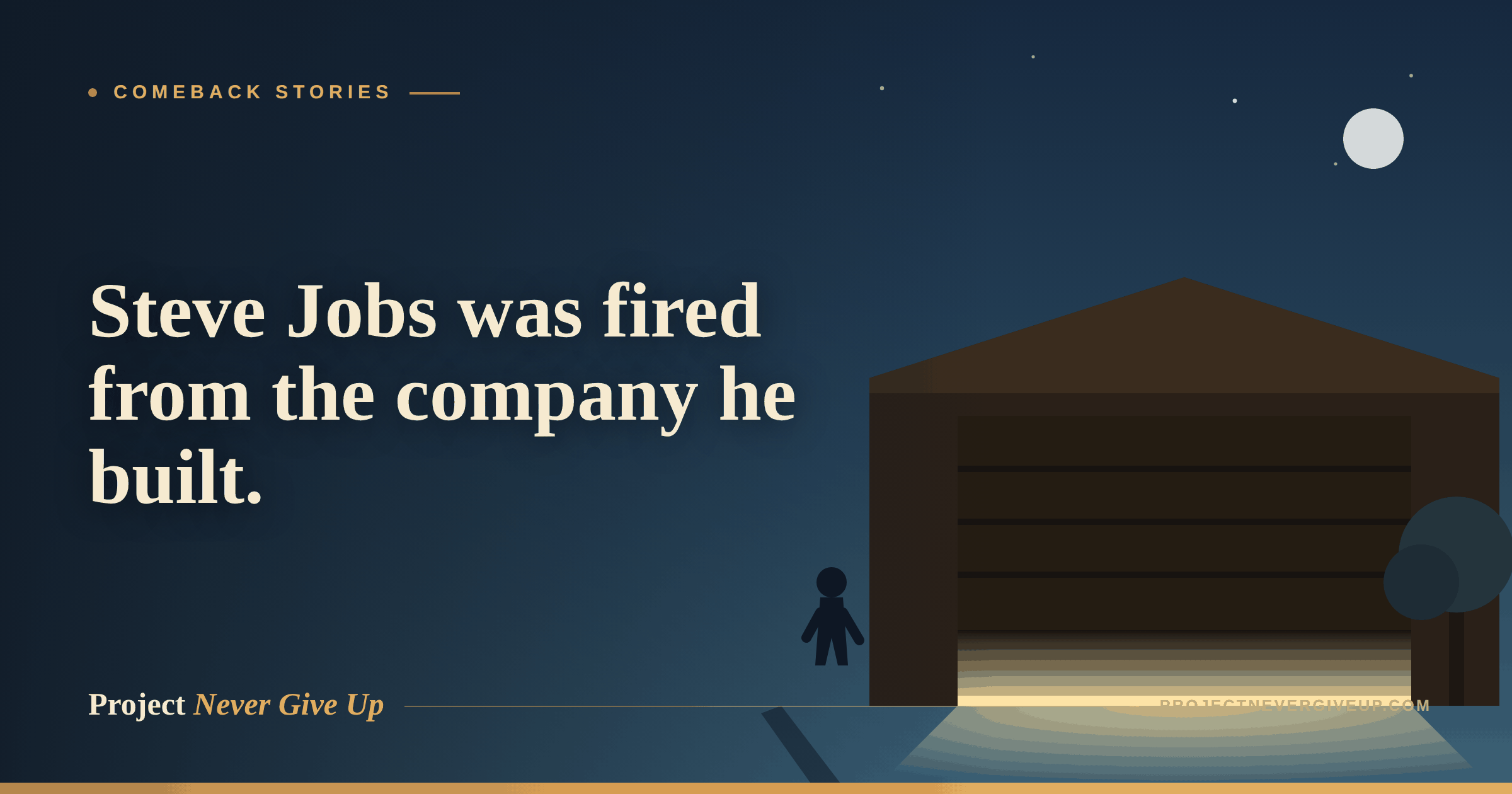
In brief: In 1985, Steve Jobs was forced out of Apple — the company he co-founded in a garage nine years earlier — at age 30. What followed was twelve years of building in the wilderness: a computer company called NeXT and a struggling animation studio called Pixar. When Apple bought NeXT in 1997 and Jobs returned as CEO, he led the company through the iPod, iPhone, and iPad — arguably the greatest corporate comeback in history.
Imagine being 30 years old and losing the thing you built with your own hands. Not losing a job. Losing the company that had consumed every waking hour of your twenties — the thing you started in a garage at twenty-one, that had just become a $2 billion company with 4,000 employees. And then being escorted out of it.
That is what happened to Steve Jobs in 1985. His own words: “What had been the focus of my entire adult life was gone, and it was devastating. I really didn’t know what to do for a few months.” (Stanford Commencement Address, 2005)
The usual story skips straight from the firing to the triumphant return. But the twelve years in between are the whole point. What Jobs did in the wilderness is the reason Apple became what it became.
The Garage, the Vision, and the Fall
Steve Jobs co-founded Apple on April 1, 1976, with Steve Wozniak and Ronald Wayne, out of the Jobs family garage. He was twenty-one. Within a decade, Apple was a $2 billion business. (Britannica)
Jobs had recruited John Sculley from PepsiCo to be CEO, famously asking: “Do you want to sell sugar water for the rest of your life, or do you want to come with me and change the world?” Then the Macintosh underperformed, and their visions diverged. In May 1985, Sculley went to the board and won. Jobs was moved to a building he bitterly nicknamed “Siberia” with no real responsibilities. (Cult of Mac)
In September 1985, Jobs resigned. He sold almost all his Apple shares — keeping just one, so he could still receive the annual reports. “I went for a lot of long walks in the woods and didn’t really talk to a lot of people,” he later said. And then something shifted.
NeXT: Building in the Dark
Jobs recruited five senior Apple engineers and founded a new computer company called NeXT. Its mission: build the most advanced workstation in the world. The hardware was stunning. The software, NeXTSTEP, was years ahead of its time. There was just one problem: almost nobody bought it. By most commercial measures, NeXT was a failure. (Wikipedia)
But in 1991, a British scientist named Tim Berners-Lee used a NeXT computer to create the first web server and browser. The machine nobody was buying became the platform on which the World Wide Web was invented. (CERN) Jobs didn’t know that yet. He was still trying to figure out whether any of this would work.
Pixar: The Side Project That Changed Cinema
In 1986, Jobs paid $10 million for the computer graphics division of George Lucas’s production company. He renamed it Pixar. Nobody in Hollywood took computer animation seriously. For years, Pixar lost money — Jobs eventually put over $50 million of his personal fortune into keeping it alive. (Wikipedia)
In 1995, Pixar released Toy Story — the world’s first computer-animated feature film. It grossed $373 million worldwide. When Pixar went public in 1996, Jobs’s stake was worth over $1 billion. The man escorted out of Apple with nothing had become a billionaire — from the things he built while Apple tried to forget him. (Britannica)
The Return
By 1996, Apple was in crisis — burning through CEOs, haemorrhaging market share, its stock at historic lows. In December 1996, Apple acquired NeXT for $400 million, bringing Jobs back. By July 1997, he was interim CEO, taking an annual salary of $1. (Wikipedia)
He cut Apple’s product line from dozens to four. He struck a deal with Microsoft. Then came the iMac (1998), iPod (2001), iTunes Store (2003), iPhone (2007), and iPad (2010). When Jobs died in 2011 at 56, Apple was the most valuable company in the world. (Britannica)
What Those Twelve Years Actually Were
Jobs didn’t return to Apple stronger despite his twelve years in the wilderness. He returned stronger because of them. NeXT built the operating system that became the foundation of modern macOS and iOS. Pixar taught him how to lead a creative organisation. Both forced him to grow into a leader he hadn’t been.
He said it himself: “It was awful-tasting medicine, but I guess the patient needed it. Sometimes life hits you in the head with a brick. Don’t lose faith. I’m convinced that the only thing that kept me going was that I loved what I did.”
He kept going because he loved the work — not because he could see where it was going. He had no idea he was coming back to Apple. He just kept building.
What This Means for You
You may be in your own version of 1985 right now — the year everything you worked for was taken. The question Jobs’s story asks is not “how do I get back what I lost?” It’s harder: what can I build with what I have left?
The twelve years were not a clean arc of recovery — they were uncertainty, investment, loss, and grinding forward without a clear destination. But they produced the iPhone. Your wilderness years are not wasted years. They are the years you become who you need to be for what comes next. Keep building. Never give up.
Frequently Asked Questions
Why was Steve Jobs fired from Apple?
Jobs was forced out following a power struggle with CEO John Sculley, whom Jobs himself had recruited. After the Macintosh underperformed, the board sided with Sculley in May 1985. Jobs resigned that September. (Cult of Mac)
What did Steve Jobs do after being fired from Apple?
He founded NeXT and purchased the graphics division of Lucasfilm, which he renamed Pixar. Both were built during his twelve years away. (Wikipedia)
How did Steve Jobs return to Apple?
In December 1996, Apple acquired NeXT for $400 million. When CEO Gil Amelio was ousted in July 1997, Jobs stepped in as interim CEO and eventually became permanent CEO. (Wikipedia)
What can we learn from Steve Jobs being fired?
That what looks like an ending is often a redirection. Jobs said the firing was the best thing that ever happened to him — it freed him to build NeXT and Pixar and grow into the leader Apple needed when he returned.
If you’re in the middle of your own 1985, Risha is here.
Want stories like this in your inbox every week? Join the Project Never Give Up newsletter — it’s free.