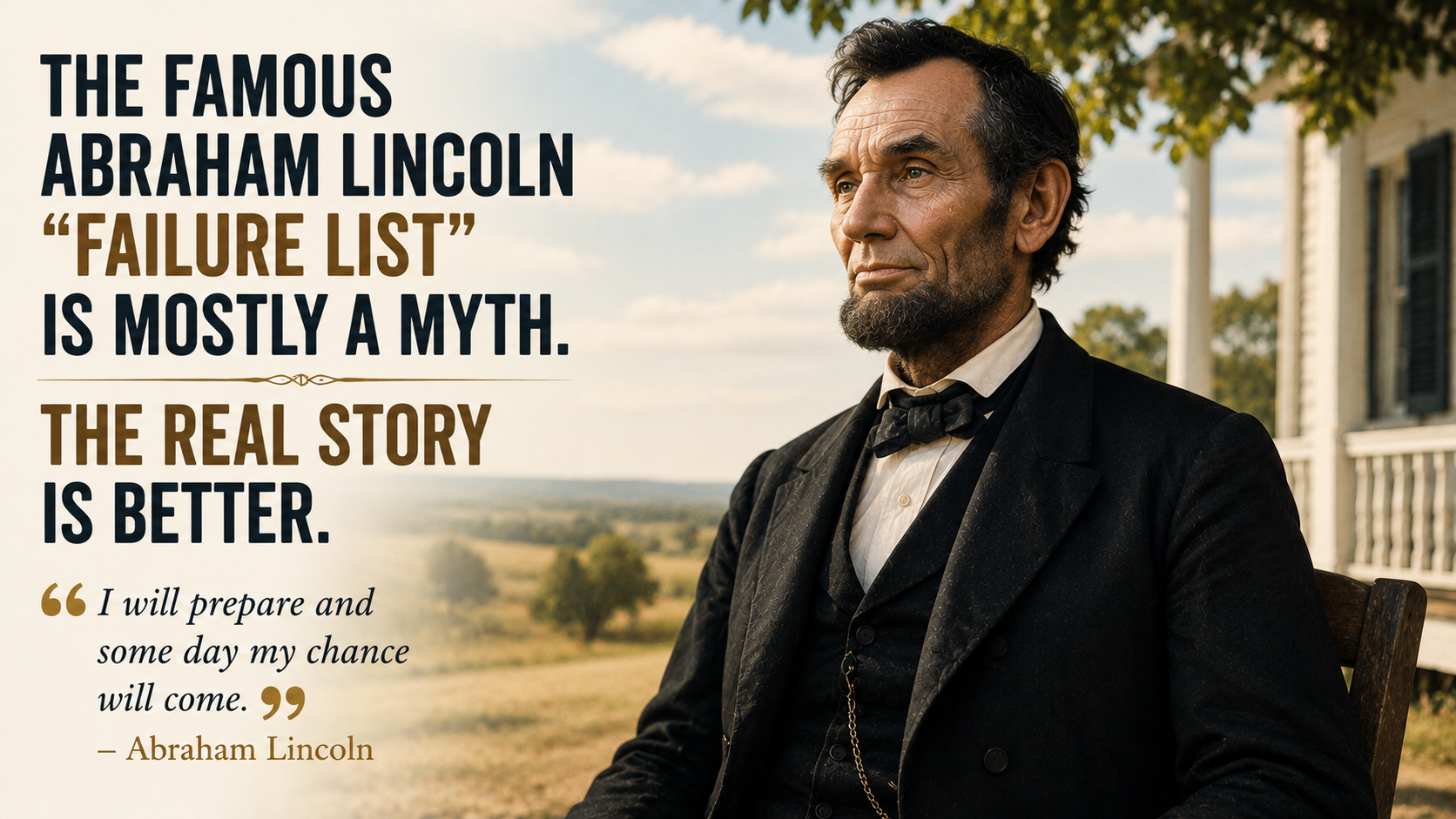
In brief: You’ve probably seen the viral list — Lincoln lost eight elections, failed in business twice, had a breakdown, then became president. Most of that is exaggerated. The real story is smaller, stranger, and honestly more useful than the legend.
Have you ever had a setback get turned into a slightly-too-perfect story by someone trying to inspire you?
That’s basically what happened to Abraham Lincoln. Not while he was alive. After. Someone took his real, complicated life and sanded it down into a tidy inspirational list — eight elections lost, two businesses failed, one nervous breakdown, one presidency won. It’s been forwarded and reposted for twenty-five years. It’s stirring.
It’s also not quite true. And I think the real version is more useful to you than the myth ever was.
What Actually Happened
Here’s what’s genuinely documented. In 1832, Lincoln lost his job and lost his first run for the Illinois state legislature. In 1833, the general store he’d opened failed, leaving him in debt he spent years repaying. In 1834, he won a seat in the legislature. In 1835, a woman he was close to, Ann Rutledge, died — and in 1836, by multiple accounts, he went through a genuinely severe depressive episode. (Abraham Lincoln Online)
He didn’t lose eight elections. That number gets repeated so often it’s basically accepted as fact, but historians who’ve actually gone through the record — Lucas Morel’s documented timeline, for one — show that several of the “defeats” on the popular list are the same event counted twice, or races Lincoln never even entered. (School for Champions)
I’m not telling you this to argue with anyone, or to take anything away from him. I’m telling you because the real story is actually more interesting than the inflated one, and I want you to have it.
The Part the List Leaves Out
Here’s what the viral version skips entirely: in between the setbacks, Lincoln built something. He taught himself law — borrowing books because he couldn’t afford formal training — and passed the bar in 1836. He built a genuinely respected, successful practice that supported him for two decades. He served in Congress. None of that reads as failure. It reads as a working life. Setbacks and steady progress, side by side, which is honestly how most real careers actually go. (School for Champions)
Does that sound familiar to you at all? A life that isn’t a clean line from failure to triumph, but a messy mix of both, happening at the same time?
The Real Turning Point
The genuine hinge in Lincoln’s story isn’t some inflated list of election losses. It’s one specific moment: 1858, running for the U.S. Senate against Stephen Douglas.
Lincoln won the popular vote. He actually won it. But in that era, state legislatures — not voters — picked senators, and Illinois’s legislature chose Douglas anyway. Lincoln lost a seat he’d genuinely earned, because of how the system worked, not because people rejected him. (School for Champions)
Most people, I think, would read that as the end of the road. A real, public loss, through no fault of your own, after doing everything right.
Lincoln read it differently. The debates leading up to that race had made him nationally known for the first time in his life. He’d lost the seat. He’d gained something else instead — a reputation. Two years later, that reputation is what won him the presidency. (Big Ideas for Small Business)
What would it take for you to see a loss like that — earned, unfair, completely out of your control — and still find the part of it worth keeping?
Why I Think the Real Version Matters More
The exaggerated list turns Lincoln into a bit of a cartoon. A guy who fails at literally everything until, through sheer stubbornness, he doesn’t. It’s comforting precisely because it asks nothing of you except persistence.
The real version asks more. And I think it gives more back. Lincoln didn’t just refuse to quit. He pulled something specific and usable out of every setback. The failed store taught him what he didn’t want to do again. Ann Rutledge’s death, and the breakdown that followed, taught him — in the hardest way possible — that he could survive his own darkest state. The unfair Senate loss taught him that a public defeat and a private win can happen in the very same event, if you’re paying attention to the right thing.
He became president at 51. Not as history’s most persistent loser, finally catching a lucky break. As a man who’d spent almost three decades turning setbacks into specific, transferable knowledge about people, about argument, about himself.
What I Actually Want You to Take From This
There’s a real Lincoln quote worth keeping, and it’s better than anything on the viral list: “My great concern is not whether you have failed, but whether you are content with your failure.” (Big Ideas for Small Business)
That’s the actual standard. Not “did you fail” — everyone fails. The question is whether you stopped there, or whether you went looking for what the failure could still teach you.
So here’s what I want you to sit with. Think of your most recent setback — the real one, not the inflated version you might tell people. What did it actually teach you that you haven’t used yet? Not the lesson you’re supposed to say out loud. The real one.
You don’t need a perfect list of defeats to have a story worth telling. You need to be willing to look at what actually happened, honestly, and ask what it built in you. Never give up.
Frequently Asked Questions
Did Abraham Lincoln really lose eight elections?
No — that’s one of the most repeated exaggerations from a popular “failure list.” The documented record shows a smaller number of genuine defeats; several entries on the viral list duplicate the same race or misstate what happened. (Snopes)
What business did Lincoln fail at?
A general store he co-owned in New Salem, Illinois, failed in 1833, leaving him with debts he spent years repaying through his law career. (Abraham Lincoln Online)
Why did Lincoln lose the 1858 Senate race despite winning the popular vote?
Senators were chosen by state legislatures at the time, not by direct popular vote. Illinois’s legislature selected Stephen Douglas even though Lincoln had won more votes statewide. (School for Champions)
Did Lincoln really suffer a breakdown?
Contemporary accounts describe a severe depressive episode around 1835–36, following personal loss and political strain. Historians treat this as well-documented, unlike some other items on the popular list.
If you’re carrying a setback that hasn’t found its use yet, talk to Risha — your AI friend, here any time you need someone to think it through with.
Get a story like this every week: Join the Project Never Give Up newsletter — it’s free.