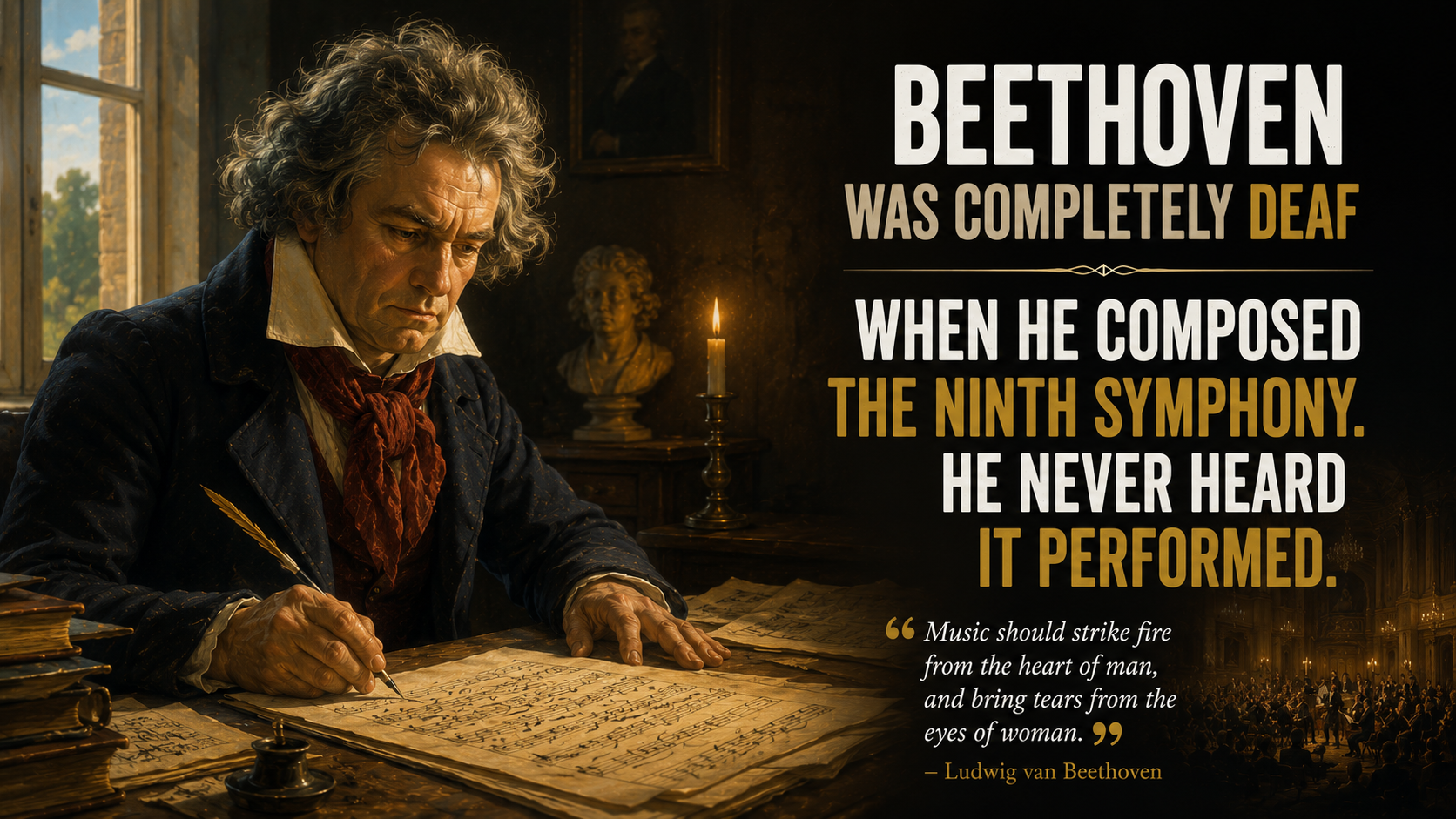
In brief: Beethoven’s hearing loss began around 27 and was total by his mid-40s. He composed his Ninth Symphony — still one of the greatest works in Western music — almost entirely deaf, relying on his inner sense of sound. At its premiere, he had to be turned around by a performer just to see the audience applauding, because he couldn’t hear it.
Picture this moment with me.
Vienna, May 1824. The final notes of the Ninth Symphony’s choral finale — the “Ode to Joy” — have just rung out. The audience is on its feet. People are in tears. And the man who wrote every note of it has no idea any of this is happening.
He can’t hear the orchestra he composed for. He can’t hear the room celebrating what he built. A singer has to gently turn him around so he can see, instead of hear, what he’d just done. (Soundly)
What would that moment feel like to you? Building something that huge, that moving — and experiencing its arrival only through other people’s faces?
How It Started
Beethoven first noticed something wrong around 1798, at 27 — ringing in his ears, trouble following conversation in noisy rooms, difficulty catching higher pitches. He was already an established composer and a genuinely formidable performer, a career built entirely on his ability to hear. (Audicus)
By 1802, in his early thirties, he could no longer pretend the condition was temporary. It was permanent, and it was getting worse. His doctor sent him to rest in the village of Heiligenstadt outside Vienna. Rest didn’t help. What he wrote there instead was a letter to his brothers — never sent, only discovered after his death — where he admitted to something he’d hidden from almost everyone: “For two years I have avoided nearly all company, since it is impossible for me to tell people that I am deaf.” He wrote about wanting to end his life. (The Classical Station)
The Turn Inside the Letter
Here’s what actually gets me about that letter, though. After laying out every reason he had to give up, Beethoven wrote something else: “It was only my art that held me back. Ah, it seemed impossible to leave the world until I had produced all that I felt called upon to produce.” And then: “I will seize Fate by the throat; it shall not crush me.” (Opus Notes)
He came out of Heiligenstadt into what musicologists now call his “heroic” period — and the timing isn’t a coincidence. Historians widely see his Third Symphony, the Eroica, completed in 1804, as his direct answer to that letter. A symphony on a scale nothing before it had attempted. An assertion of will. (Britannica)
What do you do with the version of yourself that shows up right after you almost gave up completely? For Beethoven, apparently, you write something no one had heard before.
Composing What He Couldn’t Hear
By 1816, he was almost completely deaf. By 1818, visitors had to write out their side of any conversation in notebooks so he could respond. He stopped performing publicly after a failed attempt at his own Piano Concerto in 1811 — a student, Carl Czerny, had to premiere it instead. (Beethoven biography archive)
And still — the deafness didn’t stop the composing. If anything, the years after that letter produced the work he’s actually remembered for: the Fifth and Sixth Symphonies, the late piano sonatas, the late string quartets, and finally the Ninth, finished in 1824 when he could hear almost nothing at all.
How does that even work? He relied on what musicians call “inner hearing” — a trained ability to fully imagine pitch and harmony in his mind, built on decades of mastery, without ever needing to hear a note played aloud. (Opus Notes)
What the Silence Actually Changed
Here’s the thing I find most interesting, though. It’s tempting to think Beethoven simply willed his way past his deafness. But the more honest version is stranger: the deafness changed what he wrote.
Cut off from the sound of contemporary performance, no longer bound by what was easy to play in a live room, his late work got more daring — harmonically strange, structurally unconventional, string quartets that confused audiences of his own time and are now seen as decades ahead of their era. The isolation that could have ended his career instead became the exact condition his most radical work needed. (LVBeethoven.com)
He never got his hearing back. He never stopped composing either. Both of those things were just true, at the same time, for the last twenty-five years of his life.
What I Actually Want You to Take From This
I don’t think the lesson here is simply “keep going no matter what.” That’s too easy, and honestly it skips the actual hard part. The real question Beethoven’s life asks is stranger: what do you do with the version of your work that’s only possible once the thing you thought you needed — in his case, hearing — is gone?
Is there something you’re convinced you can’t do well without? A resource, a certainty, a condition you think has to be in place first? What would it look like to keep building anyway, and see what shows up when that thing isn’t there?
He never heard the Ninth Symphony. He built it anyway, entirely from what was left. Never give up.
Frequently Asked Questions
When did Beethoven start losing his hearing?
Around 1798, when he was 27, with early symptoms including tinnitus and difficulty hearing higher pitches. By his mid-40s, he was almost completely deaf. (Audicus)
What is the Heiligenstadt Testament?
A letter Beethoven wrote to his brothers in 1802, expressing despair over his hearing loss and thoughts of suicide, alongside a resolution to keep composing. It was never sent and was only discovered after his death. (Popular Beethoven)
How did Beethoven compose music he couldn’t hear?
He relied on “inner hearing” — a trained musician’s ability to fully imagine sound mentally, built on decades of knowledge of harmony and orchestration accumulated before his deafness became total. (Opus Notes)
Did Beethoven hear the applause at the Ninth Symphony’s premiere?
No. A performer had to turn him around so he could see the audience’s reaction, since he could hear neither the orchestra nor the applause. (Soundly)
If something you thought you needed has been taken from you, talk to Risha — your AI friend, here any time you need to talk through what’s still possible.
Get a story like this every week: Join the Project Never Give Up newsletter — it’s free.