In brief: Before Harry Potter, J.K. Rowling was a single mother living on government benefits in a cramped Edinburgh flat, battling clinical depression. She wrote the first Harry Potter manuscript over five years while raising her daughter alone in poverty. Twelve agents rejected it before Bloomsbury said yes. The series went on to sell over 600 million copies. This is the verified story of the years nobody talks about.
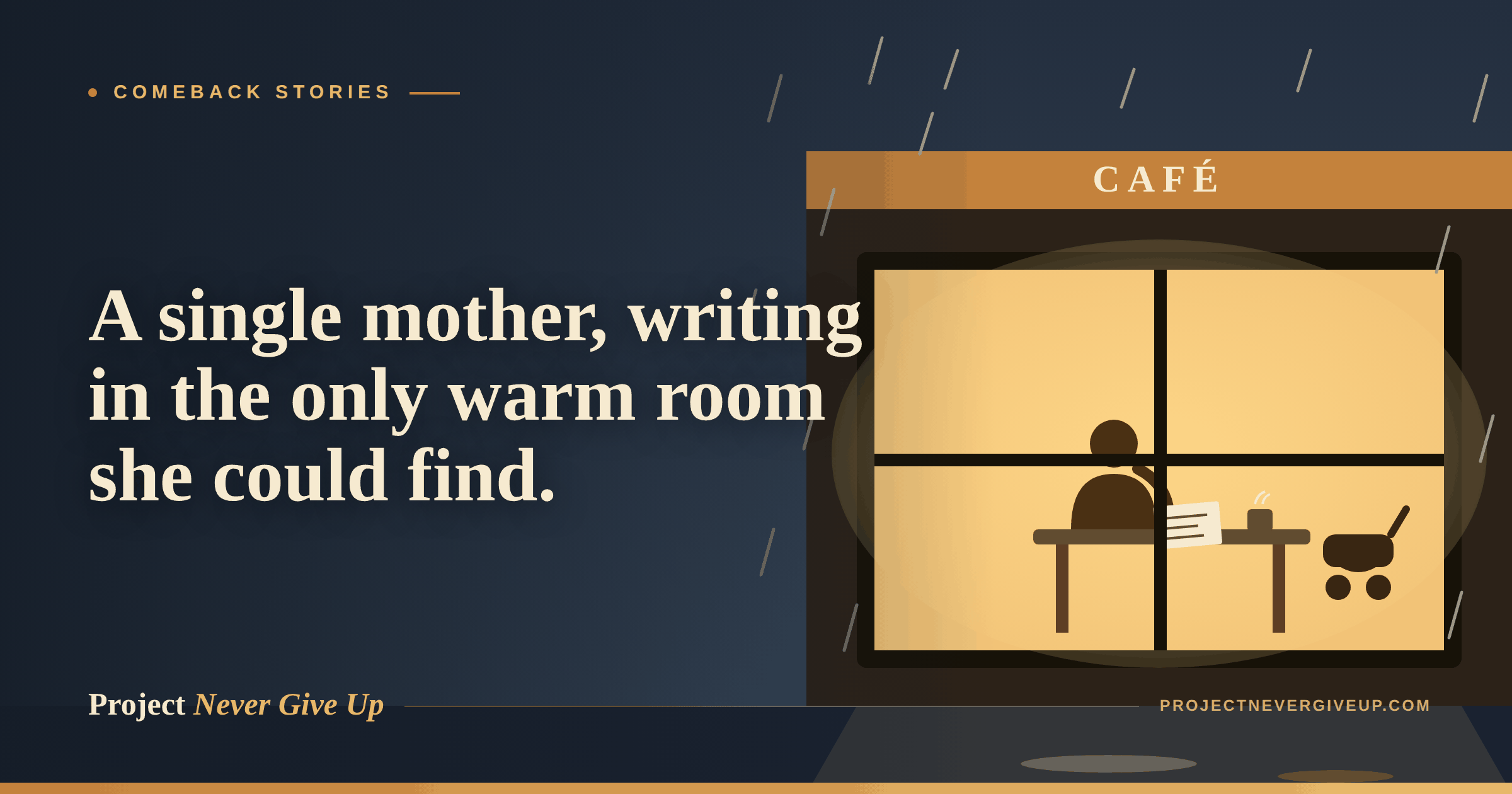
She couldn’t afford to eat at the café.
People know that J.K. Rowling wrote Harry Potter in Edinburgh cafés — it has become one of the most romanticised images in modern literary history. What gets left out is that she sat in those cafés nursing a single cup of coffee for as long as she could because it was warm, because her flat wasn’t, and because she had no money for food.
“I remember not eating so my daughter would eat,” she later told the Daily Mail. “I remember nights when there was literally no money.”
This is a story about a woman who had lost almost everything — her marriage, her mother, her career, her health — and who kept writing anyway, in the cold, alone with a sleeping baby, with no certainty it would ever amount to anything.
The Train, the Idea, and the Life That Fell Apart
Joanne Rowling was born on July 31, 1965, in Yate, England. On June 26, 1990, she was on a delayed train from Manchester to London’s King’s Cross. The train sat still for hours. She had no pen. And a fully formed idea arrived — a boy who didn’t know he was a wizard. A school for magic. An entire world. (JKRowling.com)
Within months, her mother was diagnosed with multiple sclerosis and died in December 1990. Rowling has said the death bled directly into Harry Potter — into the themes of loss and the desperate love of parents for their children. She moved to Portugal, married, had a daughter, Jessica, in 1993, and three months later left a marriage marked by domestic abuse — taking her baby and her chapters. She arrived in Edinburgh in December 1993 with a suitcase and an unfinished manuscript. (Biography.com)
The Flat, the Benefits, and the Depression
Rowling applied for Income Support. Her weekly income was around £83 to cover rent, food, nappies, heating, and everything else. She was clinically depressed. She has spoken about it with characteristic precision: “We’re talking suicidal thoughts here, we’re not talking ‘I’m a little bit miserable.'” (Rebecca’s Dream)
The thing that made her hold on was Jessica. “She was something that earthed me, grounded me. I thought: this isn’t right, this can’t be right. She cannot grow up with me in this state.” She got help. She kept going. And every morning, when Jessica napped, she wrote.
The Café, the Manuscript, and the Long March
The flat was cold. So she would put Jessica in the pram and walk to a nearby café, where it was warm, and sit with her manuscript and a cup of coffee stretched as long as possible. (FandomWire)
Picture it: a woman in her late twenties, baby asleep beside her, writing in longhand about wizards and Quidditch — on benefits, with clinical depression, after domestic abuse, after her mother’s death. Writing it anyway. Later she reflected: “Rock bottom became the solid foundation on which I rebuilt my life.” She finished the manuscript in 1995, typing it on a second-hand manual typewriter because she couldn’t afford a computer. (JKRowling.com)
Twelve Rejections
Twelve literary agents rejected the book before Christopher Little agreed to represent it. Even then, it was rejected by eight major publishers. She has kept her original rejection letter pinned to her wall. (Britannica)
The ninth publisher was Bloomsbury. Their chairman’s eight-year-old daughter read the first chapter and demanded to know what happened next. Bloomsbury offered a £1,500 advance and printed 500 copies. Her editor advised her to get a day job — the children’s book market was not a reliable source of income. (Wikipedia)
What Happened Next
Harry Potter and the Philosopher’s Stone was published on June 26, 1997 — exactly seven years after the train delay. The American rights sold to Scholastic for $105,000. The series that followed sold over 600 million copies worldwide, in 85 languages, and spawned a film franchise grossing over $9 billion. Rowling became the first author in history to become a billionaire through book sales alone — and lost that status by giving so much away to charity. (Wikipedia)
What Her Story Actually Teaches
Rowling’s story is about what a human being can build when they have nothing to protect themselves with except the work itself. She had no safety net. She had a baby, a manuscript, and the stubborn belief that the story was worth telling — even when every editor in London was telling her it wasn’t.
And she kept writing. Not heroically. She kept writing the way most people do the most important things — quietly, in the margins, in the small hours, in the cold, without an audience, without certainty. That is the real lesson. The work is the reason. The work is what grounds you when everything else is gone. Find your work. Do it in the cold if you have to. Don’t stop. Never give up.
Note: This article touches on depression and suicidal thoughts, which Rowling has spoken about publicly. If you or someone you know is struggling, please reach out. In the UK: Samaritans — 116 123. In the US: 988 Suicide and Crisis Lifeline — call or text 988.
Frequently Asked Questions
Was J.K. Rowling really on benefits when she wrote Harry Potter?
Yes. She lived on UK Income Support in Edinburgh while writing the first book. She has spoken about this in detail — including that she sometimes skipped meals so her daughter could eat. (Biography.com)
How many times was Harry Potter rejected?
Rejected by twelve literary agents before Christopher Little represented it, then by eight publishers before Bloomsbury accepted it. (Britannica)
Did J.K. Rowling really write Harry Potter in a café?
Yes — primarily because her flat was unheated and the cafés were warm. She wrote while her daughter slept in a pram beside her. (FandomWire)
What is J.K. Rowling’s most famous quote about failure?
“Rock bottom became the solid foundation on which I rebuilt my life.” — from her 2008 Harvard commencement address. (Harvard Gazette)
If you’re in your own cold café chapter right now, Risha is here — any time of day or night.
Want a story like this every week? Join the Project Never Give Up newsletter — it’s free.