In brief: Between 1979 and 1993, James Dyson spent 15 years and built 5,127 prototypes of a bagless vacuum cleaner while going deeply into debt, mortgaging his home multiple times, and being rejected by every major manufacturer in the world. When he finally launched his own company, his vacuum became the fastest-selling in British history. This is the verified story of what those 15 years actually looked like from the inside.
Most people have a Dyson in their home or know someone who does. Almost nobody knows the story behind it. Not the polished version — the real one. A man in a converted barn workshop, rebuilding the same machine for the five thousandth time, with his wife’s teacher’s salary the only thing standing between his family and financial ruin. Every company in the vacuum industry rejected his invention — not because it didn’t work, but because it worked too well and would have destroyed their most profitable revenue stream. The version that took fifteen years.
The Frustration That Started Everything
James Dyson was born in 1947 in Cromer, Norfolk, England. His father died when he was nine. He studied at the Royal College of Art, discovering a passion for engineering and design. He arrived at the late 1970s with talent, experience, and very little money. (Britannica)
In 1978, vacuuming his house in the Cotswolds, he noticed the machine losing suction. The bag was clogged with dust — and he realised the bag was always going to clog, because that was its fundamental design flaw. He had recently visited a sawmill that used a large industrial cyclone to separate sawdust from air with no filter to clog. He built a cardboard-and-tape version of the same principle and attached it to his vacuum. It worked perfectly. And it never lost suction. He had no idea it would take fifteen years to reach a shop shelf. (Dyson.com)
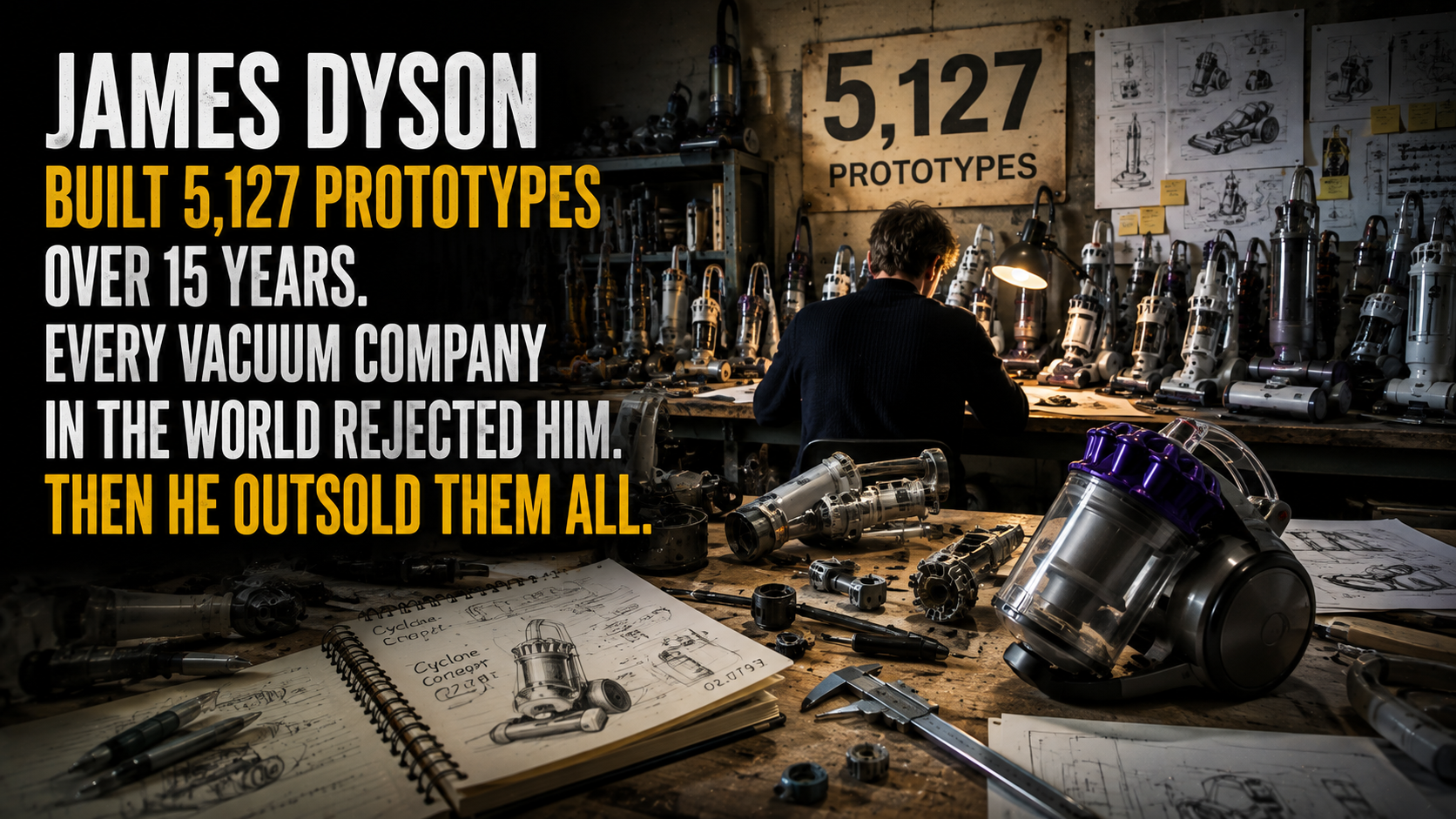
5,127 Attempts
Dyson set up a workshop in his coach house and began building prototypes. When part-time wasn’t enough, he committed fully — which meant his family lived almost entirely on his wife Deirdre’s salary as an art teacher. (Inc.)
Every prototype revealed a new problem. He rebuilt, adjusted, rebuilt again. Each failure told him something the previous one hadn’t. He didn’t experience this as defeat — he experienced it as information. After four years, in 1983, he finished prototype number 5,127 — the one that finally worked. He described his reaction: “Perhaps I should have punched the air… Instead, far from feeling elated, I felt strangely deflated.” Because finishing the prototype was not the end. It was the beginning of the next fight. (Dyson.com)
Every Door Closed
Dyson spent the next decade trying to license his design to established manufacturers across the UK, Europe, the US, and Japan. They all said no. The reason was not that the technology didn’t work — it was that it worked too disruptively. The vacuum bag market in Europe alone was worth over $500 million annually. A bagless vacuum eliminated their most reliable income stream entirely. They understood exactly what Dyson had built. And that is precisely why they didn’t want it. (Dyson.com)
Through the rejections and the debt, his wife Deirdre kept teaching and kept the family stable. She never asked him to stop. Dyson has credited her with making everything possible. (Inc.)
Going Alone
In 1993 — fifteen years after that first frustration — Dyson founded Dyson Ltd. and manufactured the DC01 himself. The dominant British retailers wouldn’t take his calls. He found his way in through catalogue sales and smaller retailers. Then word spread — not through advertising, but through customers who used the machine and told other people. (Intellectual Software)
Within two years, the DC01 was the best-selling vacuum cleaner in Britain — outselling every competitor at a higher price. The manufacturers who had rejected him tried to launch their own bagless vacuums; Dyson sued them for patent infringement and won most cases. Today Dyson Ltd. generates billions in annual revenue, and Dyson’s net worth is estimated at over $7 billion. (Britannica)
What Those 15 Years Actually Were
Dyson, looking back: “I made 5,127 prototypes of my vacuum before I got it right. There were 5,126 failures. But I learned from each one. So I don’t mind failure. I’ve always thought that schoolchildren should be marked by the number of failures they’ve had.” (Inc.)
He was not waiting for a breakthrough. He was building knowledge, one failed prototype at a time. By prototype 5,000 he understood the cyclone vacuum better than anyone on earth — not despite failing 5,000 times, but because of it. The people who control the existing market will almost always have a structural reason not to let you in. The way through is not to convince them. It is to build something so demonstrably better that the market makes the choice for you. Dyson didn’t need the manufacturers. He needed the customers. Keep building. Never give up.
Frequently Asked Questions
How many prototypes did James Dyson build?
5,127 prototypes over approximately four years (1979–1983). The full journey from first prototype to commercial launch took fifteen years. (Dyson.com)
Why did vacuum companies reject Dyson’s invention?
Because the vacuum bag market was worth over $500 million annually in Europe alone. A bagless vacuum eliminated the need for replacement bags entirely, destroying one of the industry’s most reliable revenue streams. (Dyson.com)
How did Dyson finally get his product to market?
He founded his own company in 1993 and manufactured the DC01 himself, selling through catalogues and smaller shops. Word of mouth drove adoption until it became the best-selling vacuum in Britain within two years. (Wikipedia)
What is James Dyson worth?
Over $7 billion — built entirely from the vacuum idea that every major manufacturer had rejected. (Britannica)
Still in the middle of building something nobody believes in yet? Risha is here.
Get a story like this every week: Join the Project Never Give Up newsletter — it’s free.