In brief: The phrase “overnight success” is one of the most misleading ideas in modern culture. When you examine the actual timelines of famous companies and individuals, a strikingly consistent pattern emerges: most “sudden” successes took between 6 and 16 years of unglamorous work before the world noticed. This data-driven analysis breaks down the real numbers behind the myth — and explains why believing in overnight success is one of the most common reasons people give up too early.
There is a specific moment that ruins a lot of people. It is the moment they compare their own slow, unglamorous progress to someone else’s apparent overnight success — and conclude that because it is not happening quickly for them, it is not going to happen at all.
The problem is that the overnight success they are comparing themselves to almost never existed. What they are seeing is the moment of public visibility, with all the invisible years that preceded it edited out. This article does something the motivational genre rarely does: it puts actual numbers to the myth. How long did the famous “overnight successes” actually take? We went through the timelines. The answer is remarkably consistent.
The Headline Number: Roughly a Decade
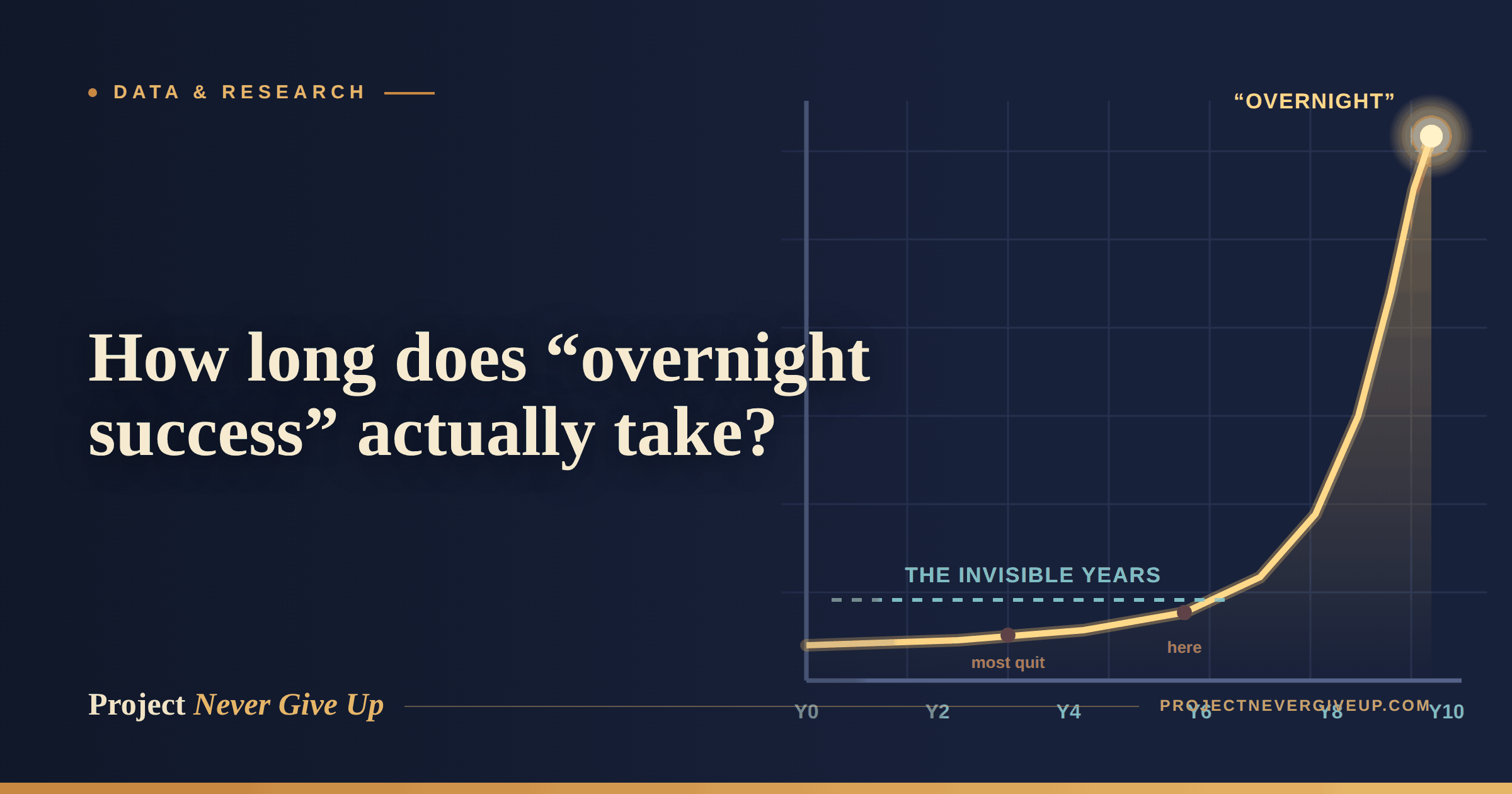
When you examine the gap between when a now-famous company started and when they achieved the success the public associates with them, the average lands consistently in the range of 6 to 10 years — with many taking considerably longer. (SmallBizClub)
Seth Godin: “It takes about six years of hard work to become an overnight success.” And the data suggests he was being optimistic. Twitter co-founder Biz Stone: “Timing, perseverance, and 10 years of trying will eventually make you look like an overnight success.” (Knowledge Enthusiast) These are descriptions of a pattern that shows up every time you check the actual timelines.
The Data: How Long It Actually Took
Airbnb — Founded 2007, “exploded” 2011. A 4-year invisible period during which it nearly died multiple times, at one point funding itself by selling novelty cereal boxes.
Notion — Founded 2013, culturally ubiquitous around 2020. A 7-year gap; the company nearly ran out of money and rebuilt its product almost from scratch.
Figma — Started 2012, an industry standard around 2020. An 8-year gap before the “sudden” dominance.
Starbucks — It took 16 years before Starbucks expanded meaningfully outside Seattle. The global phenomenon only began after 1988. (Titan)
Microsoft — Founded 1975; six years to the pivotal IBM contract (1981), then five more to the 1986 IPO — an 11-year arc. (Cayenne Consulting)
Rovio (Angry Birds) — The studio built 51 games that went nowhere before Angry Birds. The company was near bankruptcy by the time its “overnight” hit arrived. (Titan)
Even the rare exception proves the rule. Amazon is often cited as the fastest — Bezos reached billionaire status in about 3 years — and it’s described in the research literature explicitly as the “lottery odds” outlier. (Remote-First Coaching)
Why the Timelines Get Erased
1. Narrative compression. Storytellers need a clean arc, so the nine or ten years of grinding get cut. 2. Survivorship bias. You only hear about the ones who made it; the thousands who followed the same slow path and stopped at year four leave no trace. 3. Overnight success is really overnight exposure — the public sees the moment of discovery and mistakes it for the moment of creation. 4. We want to believe it — the lottery-ticket version is more appealing than the decade-of-grinding version. (Foundra)
The Data on Giving Up Too Early
If you believe success should arrive quickly, then the absence of quick success reads as evidence of failure. And the data shows this is precisely when people quit — in the middle, right when the invisible compounding is happening but hasn’t surfaced.
According to the US Bureau of Labor Statistics, roughly 50.5% of businesses survive to their fifth year — which means the popular “90% of businesses fail” claim is itself a myth. (LLC.org / US BLS) Research drawing on Harvard Business School studies found first-time founders succeed at roughly 21%, previously-failed founders at about 22%, and previously-successful founders at around 30%. Experience compounds. (The Lonely Entrepreneur) And startups that pivot once or twice show 3.6x better user growth and raise 2.5x more money than those that don’t. (Failory / Startup Genome)
What the Four Phases Actually Look Like
Years 0–2: Crawling. Almost nothing works. Most people quit here, convinced the lack of traction is a verdict. Years 2–5: Grinding. Slow, almost invisible improvement. This is where the second-largest group quits. Years 5–8: Compounding. The invisible work starts to connect; small wins accumulate. Years 8–10+: The “overnight” moment. The world suddenly notices. To outside observers, it looks instantaneous. The critical insight: the “overnight” moment is only possible because of years two through eight, which felt like failure the entire time. (Foundra)
What This Data Actually Means for You
If you take one thing from these numbers, let it be this: the feeling that it is taking too long is not evidence that it isn’t working. That feeling is the single most predictable feature of the entire journey. The Airbnb founders selling cereal. Rovio building 51 failed games. James Dyson building 5,127 failed prototypes over 15 years. Starbucks spending 16 years before it left Seattle.
There is only visible success and invisible work, and the invisible work always comes first and always takes longer than anyone watching would guess. You are probably somewhere in years zero through five right now. It probably feels slow. The data says: that is exactly what this stage is supposed to feel like. Keep going. Never give up.
Frequently Asked Questions
How long does it really take to become successful?
Based on documented timelines, most “overnight” successes took between 6 and 16 years from starting to widely-recognised success. Seth Godin’s often-cited estimate is “about six years,” though the data suggests the true average is closer to a decade. (SmallBizClub)
Is “90% of businesses fail” true?
No — it is a myth. According to the US Bureau of Labor Statistics, roughly 50% of businesses survive to their fifth year and around 33–37% survive to ten years. (LLC.org / US BLS)
Do people who fail the first time do better on their second attempt?
First-time founders succeed at about 21%, previously-failed founders at about 22%, and previously-successful founders at about 30%. Experience compounds — primarily when its lessons are genuinely absorbed and applied. (The Lonely Entrepreneur)
What is the difference between overnight success and overnight exposure?
Overnight exposure is when the public suddenly notices work that has actually been developing for years. As Jonathan Fields put it, “overnight success is really overnight exposure.” The work was always there — only the attention is new. (UX Myths)
If the slow middle is wearing you down, Risha is here — someone to talk it through with, any time.
Want more data-driven resilience analysis like this every week? Join the Project Never Give Up newsletter — it’s free.
Sources
- LLC.org — Startup Failure Rate Statistics (US Bureau of Labor Statistics)
- The Lonely Entrepreneur — The Resilience Advantage (Harvard / NY Fed)
- Failory — Startup Failure Rate (Startup Genome)
- Foundra — The Overnight Success Myth
- Titan — The Startup Myth of Overnight Success
- Cayenne Consulting — An Overnight Success Takes Years
- UX Myths — Success Happens Overnight