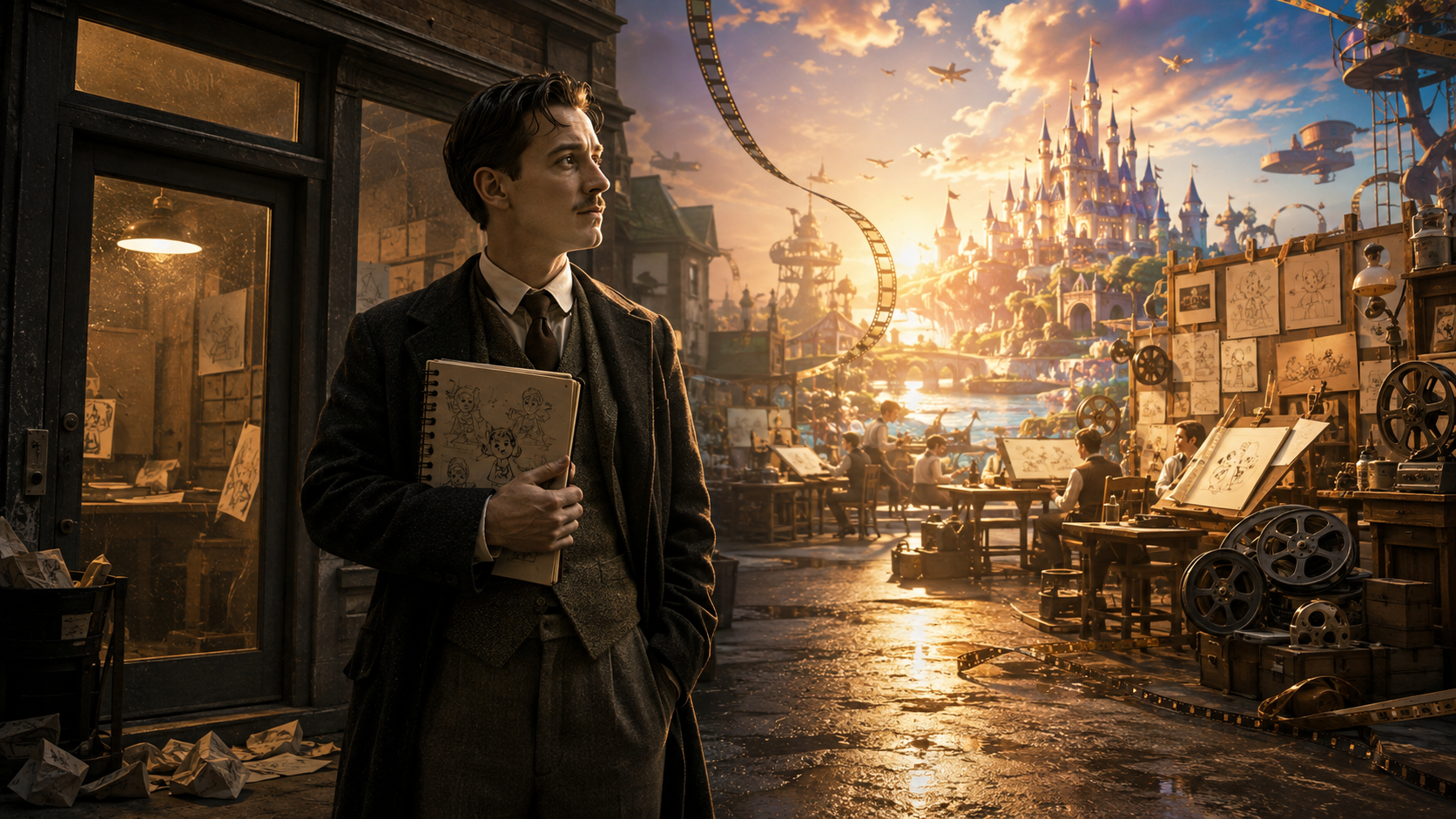
Have you ever been told you’re not good enough at the one thing you love most?
Not by a stranger. Not by an anonymous comment on the internet. But by someone in authority — someone whose verdict felt final, official, and devastating.
That’s what happened to Walt Disney in 1919. He was eighteen years old, working at the Kansas City Star newspaper, drawing for a living. His editor called him in, looked him in the eye, and told him he was being let go.
The reason? He “lacked imagination and had no good ideas.”
The man who would go on to create Mickey Mouse, Snow White, Cinderella, Disneyland, and a $130 billion entertainment empire — the man who would win more Academy Awards than any individual in history — was told at the start of his career that he had no imagination.
He didn’t argue. He didn’t beg. He walked out of the building and started drawing again.
What happened next is not a clean story of triumph. It is a long, brutal, expensive, lonely journey through failure after failure — with one man’s conviction burning at the centre of all of it, refusing to go out.
This is that story.
The Boy Who Drew Everything
Walter Elias Disney was born on December 5, 1901, in Chicago, Illinois. He grew up mostly in Marceline, Missouri — a quiet farming town where he spent his childhood drawing animals, landscapes, and anything that held still long enough. He drew on whatever he could find. He sold sketches to neighbours. He drew for his high school newspaper. Art wasn’t something Walt did. It was something Walt was. (Britannica)
At sixteen, he tried to enlist in the army during World War I. Too young by a year, he altered his birth certificate and joined the Red Cross as an ambulance driver in France instead. He came home at eighteen with a head full of images and nowhere particular to put them — so he went looking for a job as a commercial artist. (Wikipedia)
The Kansas City Star hired him. Then fired him.
No imagination. No good ideas.
Most people, handed that verdict at eighteen by a man with the authority to make it stick, would absorb it. Would quietly wonder if it was true. Would find something safer to do.
Walt Disney went and found a camera.
The Studio That Fell Apart — And the Mouse That Was Born In It
Disney threw himself into animation. He and his friend Ub Iwerks began producing hand-drawn cartoon shorts and struck a deal with a local Kansas City theatre to screen them. The cartoons were good enough that Walt was able to open his own studio — Laugh-O-Gram Films — hire a team of young animators, and start building something real. (Wikipedia)
He was twenty years old. He was building a studio. He was making cartoons that people were watching. It felt like the beginning of everything.
Then the distributor who owed them $11,000 went bankrupt. The money never came. Disney tried everything — cutting staff, cutting salaries, cutting his own pay, skipping meals. He gave his remaining animators shares of stock in lieu of wages, not yet understanding those shares would become worthless. One by one, the people around him left. (SlashFilm)
By the summer of 1923, Walt Disney was completely alone in the Laugh-O-Gram office. No money. No staff. No way forward. He couldn’t afford rent, so he slept on the studio couch. He couldn’t afford food, so he scavenged. He bathed once a week at the local Union Station — ten cents a visit — because it was the cheapest option available to him. (Wikipedia)
Imagine that. The future creator of the most magical place on earth, washing himself at a train station for ten cents because that’s all he had.
Late at night, alone in the office, he wasn’t entirely alone. There were mice living in the wastepaper baskets. Walt caught one — a small, brave one that kept returning to his drawing board — and put it in a wire cage on his desk. He grew fond of it. He sketched it. He let it go when he finally left for California. (Joshua Kennon)
Some people believe that mouse — the real one, scurrying around a bankrupt studio in Kansas City — was the original inspiration for Mickey Mouse. Walt never confirmed it. But he never denied it either.
In July 1923, Laugh-O-Gram Films filed for bankruptcy. Walt raised his train fare to Los Angeles by going door to door offering photography services. He left Kansas City with $40, an unfinished reel of film, threadbare clothes, and a used suit a family friend had given him — all packed into a cardboard suitcase. (SlashFilm)
He was twenty-one years old. Bankrupt. Alone. Starting again.
And here is the thing that makes Walt Disney extraordinary: he later said of that period — the sleeping on the couch, the ten-cent baths, the empty studio, the failure — “I was happy all the time. I was excited. I was doing things.” (Billy Oppenheimer / X)
Not bravado. Not performance. That was the truth of how he experienced it. The outside world saw ruin. Walt Disney saw a workshop.
Hollywood, Oswald, and the Day He Lost Everything Again
In Los Angeles, his brother Roy was recovering from tuberculosis. They had each other, and very little else. Together, they borrowed money from family and started again — the Disney Brothers’ Cartoon Studio, operating out of their uncle’s garage. (Wikipedia)
After months of rejection from every studio in Hollywood, Disney struck a distribution deal with Margaret J. Winkler for a series of cartoons called the Alice Comedies — a live girl in an animated world. They found an audience. Things slowly, cautiously, started to work.
Then came Oswald the Lucky Rabbit. A new character, crisper and funnier than Alice. Audiences loved him. Disney travelled to New York in early 1928, full of momentum, ready to negotiate a better deal for the next series of Oswald cartoons.
What he found there destroyed everything he had built — again.
His distributor — now Margaret Winkler’s husband, Charles Mintz — had spent months quietly poaching Disney’s best animators, offering them higher wages to work directly for him. And because of a contract clause Disney hadn’t fully understood when he signed it, Mintz owned the rights to Oswald entirely. The message was simple: accept a pay cut and work under Mintz, or walk away with nothing. (Wikipedia)
Disney walked away.
He boarded the train back to Hollywood. His character was gone. His animators were gone. His income was gone. He was twenty-six years old and starting from nothing for the third time.
He picked up a pencil and started drawing on the train.
The Mouse That Changed Everything
On that train ride — broke, betrayed, staring out at the American landscape rolling past — Walt Disney sketched a new character. A small, cheerful mouse with round ears, red shorts, and yellow shoes. He had a name for him immediately: Mortimer.
His wife Lillian, sitting beside him, shook her head. Mortimer sounded pompous, she said. She suggested Mickey instead. (Britannica)
Mickey Mouse’s first two cartoons were silent — standard for the time. But Walt Disney had been watching what was happening in Hollywood. Sound was coming. He was going to be first.
On November 18, 1928, Steamboat Willie premiered at the Colony Theatre in New York — the first cartoon with fully synchronised sound. Audiences had never seen or heard anything like it. The reaction was immediate and overwhelming. Mickey Mouse was an overnight sensation, and this time, Disney owned him completely. (Wikipedia)
He never sold his creative rights again.
“Disney’s Folly” — The Film Nobody Believed In
By the mid-1930s, Disney Studios was established, successful, and growing. Mickey Mouse had made Walt Disney a household name. The Silly Symphonies were winning Academy Awards. Things were, for the first time, stable.
Walt Disney wasn’t interested in stable.
In 1934, he called his animators into a meeting and described his vision for the studio’s next project: a feature-length animated film. Seventy minutes. Full story. Real emotion. Based on Snow White and the Seven Dwarfs. (Wikipedia)
The Hollywood press immediately nicknamed it “Disney’s Folly.” The idea of audiences sitting through a feature-length cartoon was considered absurd — a vanity project that would bankrupt the studio. His brother Roy thought it was too risky. His own wife had doubts. Bankers refused to lend him the money to finish it. (Biography.com)
Disney made it anyway — three years of work, a team of hundreds, a budget that kept growing and growing. In the projection room he called the “Sweatbox,” he reviewed every single scene obsessively, sending them back for revision again and again until the emotional beats felt exactly right. The forest scene where Snow White flees in terror was redone so many times that animators lost count. (Inspired Founders)
Snow White and the Seven Dwarfs premiered on December 21, 1937, at the Carthay Circle Theatre in Hollywood. Critics wept. Grown men cried during the film. The audience gave a standing ovation. (Inspired Founders)
It became the highest-grossing film of 1938 — equivalent to over $175 million in today’s money. Disney’s Folly saved the studio and launched an era of animated filmmaking that reshaped cinema forever. (Wikipedia)
The Park That “Would Never Work”
One afternoon in the early 1950s, Disney sat on a bench at Griffith Park in Los Angeles, watching his daughters ride a merry-go-round. He looked at the shabby rides, the peeling paint, the general grimness of the place — and felt something he couldn’t shake. Parents and children were supposed to experience joy together here. Instead, the parents sat on benches, bored, while the kids rode alone. (Britannica)
He wanted to build something different. Something clean, imaginative, and magical. A place where parents and children could be together in the same wonder.
Everyone he told thought he was losing his mind. His wife Lillian. His brother Roy. The bankers, who rejected his loan applications over and over. Roy, who had stood by Walt through every failure, drew the line at this one. (Wikipedia)
Walt Disney mortgaged his own life insurance policy, sold his vacation home in Palm Springs, and kept going.
Disneyland opened on July 17, 1955, in Anaheim, California. Opening day was a genuine disaster — counterfeit tickets caused overcrowding, rides broke down in the heat, the asphalt on Main Street was so freshly laid that women’s heels sank into it, food ran out, and the water fountains didn’t work. The press called it “Black Sunday.” (History.com)
Within seven weeks, one million people had visited.
Within a year, it was one of the most visited places on earth. Today, Disney Parks generate over $9 billion in annual revenue. (Statista)
What He Left Behind
Walt Disney died on December 15, 1966, at the age of 65 — before Disney World, which he had already begun planning, opened its doors. He never saw it completed. (Wikipedia)
In his lifetime, he and his studio won 48 Academy Awards — more than any individual in history. He created characters and stories that are now woven into the childhoods of billions of people across every country on earth. The Walt Disney Company today is worth over $130 billion. (D23)
It was all built by a man his first editor dismissed as having no imagination.
What His Story Actually Teaches
Think about the arc of what you just read.
Fired at 18 for lacking imagination. Bankrupt and bathing at a train station for ten cents at 21. Betrayed and stripped of his character at 26. Mocked by Hollywood at 33. Rejected by banks and his own brother for Disneyland at 50.
At every single stage, someone with authority, experience, or money looked at what Walt Disney was trying to build and told him it wouldn’t work.
And here’s what makes his story different from the usual “they said no, then I succeeded” narrative: Walt Disney wasn’t just resilient. He was curious. He didn’t experience his failures as punishment. He experienced them as information. As tuition. As the material he needed to build the next thing.
He said it himself: “I think it’s important to have a good hard failure when you’re young. Because of it, I’ve never had any fear in my whole life when we’ve been near collapse. I’ve never been afraid.”
That’s not the mindset of someone who survived failure. That’s the mindset of someone who understood what failure was for.
Maybe you’re in the middle of your Laugh-O-Gram chapter right now. Sleeping somewhere you shouldn’t have to sleep. Watching something you built collapse. Wondering if it was all a mistake.
Or maybe you’re on the train back from New York — everything you worked for just taken from you in a single meeting, and nothing in your hands but a pencil and a blank page.
Pick up the pencil. Start drawing.
The editor who fired Walt Disney for lacking imagination is completely unknown today. The man he fired is on lunchboxes, theme parks, and television screens in every country on earth.
Keep going. Never give up.
Frequently Asked Questions
Was Walt Disney really fired for lacking imagination?
Yes. In 1919, Disney was fired from the Kansas City Star newspaper by an editor who told him he “lacked imagination and had no good ideas.” It is one of the most documented early setbacks in his career. (Inc. / Business Insider)
Did Walt Disney go bankrupt?
His first animation company, Laugh-O-Gram Films, went bankrupt in 1923. Walt Disney himself was not personally declared bankrupt, but the company he founded and ran was forced into bankruptcy proceedings after a distributor who owed them money failed to pay. (American Bankruptcy Institute)
What was “Disney’s Folly”?
This was the nickname given by the Hollywood press to Snow White and the Seven Dwarfs — Disney’s plan for the world’s first feature-length animated film. Most industry insiders were convinced it would be a financial disaster. It became the highest-grossing film of 1938. (Wikipedia)
How many Academy Awards did Walt Disney win?
Walt Disney and his studio won 48 Academy Awards — more than any individual in the history of the awards. (D23)
What can we learn from Walt Disney’s story?
That failure is not the opposite of success — it is part of the process. Disney didn’t just survive rejection and bankruptcy; he used them as fuel and tuition, building something greater each time he was forced to start again.
Feeling like you need someone in your corner right now? Risha is here — an AI companion built for the hard moments, available any time you need to talk.
Want stories like this delivered to your inbox every week? Join the Project Never Give Up newsletter — it’s free.
If this story moved you, read about how Jyothi Reddy stepped back from a well in a rice paddy and built a $15M company, or how Michael Jordan cried alone in his room after being cut — and came back to win six championships.
Sources
- Wikipedia — Walt Disney
- Britannica — Walt Disney
- Biography.com — Walt Disney
- D23 Official Disney Fan Club — Walt Disney Biography
- Wikipedia — Laugh-O-Gram Studio
- SlashFilm — How Walt Disney’s First Cartoons Drove Him to Bankruptcy
- Joshua Kennon — A Look at Laugh-O-Gram Films
- American Bankruptcy Institute — Walt Disney Never Filed Bankruptcy
- Wikipedia — Oswald the Lucky Rabbit
- Wikipedia — Steamboat Willie
- Wikipedia — Snow White and the Seven Dwarfs (1937)
- Wikipedia — Disneyland
- History.com — Disneyland’s Disastrous Opening Day
- Inspired Founders — Walt Disney: Bankruptcy to Empire
- Inc. / Business Insider — Successful People Who Rebounded After Getting Fired
- Statista — Walt Disney Company Revenue