In brief: Most people know Florence Nightingale as the “Lady with the Lamp” who nursed soldiers in the Crimean War. Almost nobody knows what came after — that she returned home in 1856 with a chronic illness that left her bedridden for the rest of her life, and that from that single room she invented modern nursing, pioneered the use of statistics in public health, designed hospitals, and wrote over 130,000 letters campaigning for reform. The most extraordinary chapter of her life is the one nobody talks about.
Here is a question almost nobody asks about Florence Nightingale: what did she do after the war? The story that gets told ends in the Crimea — the lamp, the wards, the fame. She comes home a heroine. And then, in most tellings, she fades politely into history.
The truth is almost exactly the opposite. Her work after the war was more consequential than anything she did during it. She spent the next forty years — from her sickbed, barely able to leave her room — waging a relentless campaign that transformed hospitals, nursing, public health statistics, and the sanitation of entire armies. She did it all without standing up. That is the story worth telling.
The Woman Nobody Expected
Florence Nightingale was born on May 12, 1820, in Florence, Italy to a wealthy English family. Her father believed his daughters deserved a full education — unusual for the era. She was taught mathematics, philosophy, and multiple languages, which made the life available to upper-class Victorian women feel like suffocation. (Britannica)
At 16, she believed she heard a calling to serve others. Her family strenuously resisted — nursing in Victorian England was not a respectable profession. It took her until 31 to begin training properly, and until 33 to get her first real appointment. She was already fighting harder than most people fight in a lifetime before she reached the Crimea.
The War, the Lamp, and the Numbers Nobody Else Was Looking At
In October 1854, Nightingale led a team of nurses to the Barrack Hospital in Scutari. The wards were filthy and freezing. Soldiers were dying not from wounds but from cholera, typhus, and dysentery — preventable diseases caused by the conditions of the hospital itself. The mortality rate when she arrived was approximately 42%. By the end of the war, it had fallen to approximately 2%. (EBSCO Research)
But what set her apart was not the lamp. It was what she was doing with the numbers. While treating patients, she was also counting them — recording causes of death, tracking mortality by month and ward. She was running one of the first systematic medical data collection exercises in military history, specifically because she intended to use the data to force reform after the war. She was building her evidence under fire, in a plague hospital, by candlelight. (Science Museum)
The Illness That Should Have Ended Everything
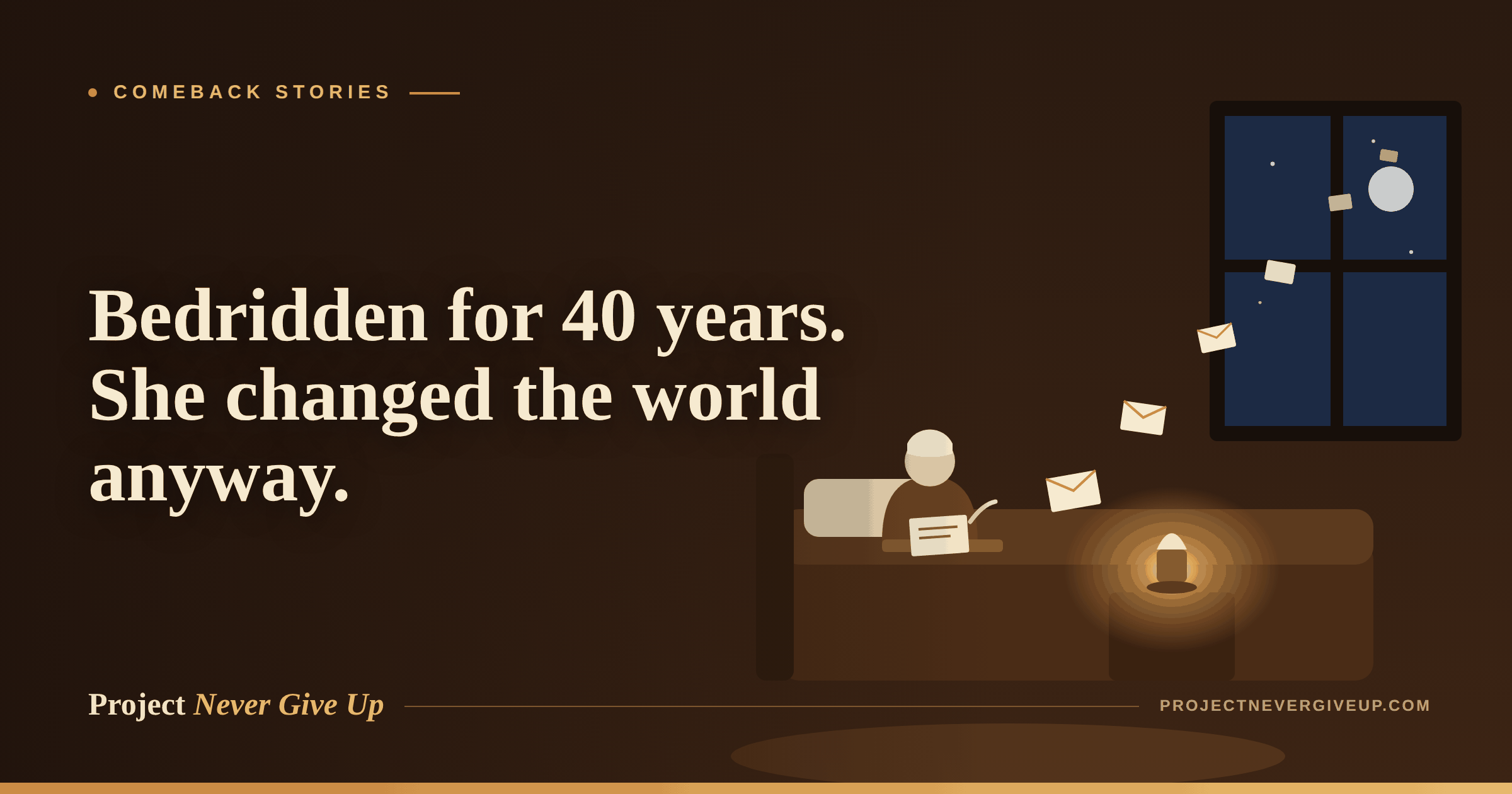
In May 1855, Nightingale fell gravely ill with what was then called “Crimean fever” — now believed to have been brucellosis. When the war ended in 1856, she returned to England a national heroine. Queen Victoria received her personally. Then she collapsed. The chronic brucellosis left her largely bedridden from 1857 onward. She rarely left her home on South Street, and for many years did not leave her room at all. (Wikipedia)
She was 37. The woman who had just transformed military medicine was now unable to stand for any significant period. Almost everyone assumed her active life was over. She did not assume that.
The Room, the Letters, and the Reform That Followed
Over her life, Nightingale wrote more than 130,000 letters — to politicians, military commanders, Queen Victoria, and anyone with the power to implement what she advocated. She submitted evidence to Royal Commissions and ghostwrote reports for male colleagues who could appear where she could not. (British Red Cross)
And crucially, she invented a new way of presenting her data. Working with statistician William Farr, she developed the polar area chart — a revolutionary visualisation showing at a glance that most deaths in military hospitals were from preventable disease, not battle wounds. In 1858 she was elected the first female fellow of the Royal Statistical Society. The charts were distributed to MPs and ministers. They were impossible to argue with. Reform followed. (Science Museum)
What She Built From That Room
In 1860, she established the Nightingale Training School for Nurses at St Thomas’ Hospital — the world’s first secular nursing school, which professionalised nursing and spread its model worldwide. She wrote Notes on Nursing (1860), still foundational to the profession. She achieved sweeping reforms to British Army medicine and applied her statistical methods to civilian hospitals and workhouses across Britain — all without leaving her room for significant stretches of a decade at a time. (Britannica)
The Chapter Nobody Teaches
Nightingale is taught as the woman with the lamp. That framing makes her story smaller than it is. The lamp was one chapter. What came after — the bedridden, ill, exhausted woman who refused to accept that her incapacity was the end of her usefulness — is the chapter that actually changed the world.
She could not walk the corridors of power, so she sent 130,000 letters. She could not stand before a committee, so she put her data in charts that could not be ignored. She died on August 13, 1910, at 90. The structures she built outlasted everything.
“I attribute my success to this: I never gave or took any excuse.” She was bedridden when she built most of what made her legendary. The illness was not the obstacle. It was the condition under which the most important work happened. Whatever your current constraint, consider the woman on South Street, writing her 50,000th letter, changing the world one argument at a time. Never give up.
Frequently Asked Questions
What did Florence Nightingale do after the Crimean War?
She spent the next 54 years largely from her sickbed — establishing the world’s first professional nursing school, reforming British military medicine, pioneering statistical graphics in public health, and writing over 130,000 letters. (Britannica)
Was Florence Nightingale really bedridden?
Yes. She contracted chronic brucellosis in the Crimea and returned largely incapacitated. The majority of her most influential work was done from bed. (Wikipedia)
What is Florence Nightingale’s most important achievement?
Most historians point to the founding of professional nursing. But her pioneering use of statistics and data visualisation to drive public health reform is increasingly recognised as equally transformative.
How many letters did Florence Nightingale write?
Over 130,000 — one of the most sustained letter-writing campaigns in history, driven primarily from her sickbed over five decades. (British Red Cross)
If you’re navigating a constraint that feels like it should stop you, Risha is here — any time.
Want stories like this every week? Join the Project Never Give Up newsletter — it’s free.